I had planned to spend Saturday doing something completely ordinary: clearing an overgrown corner of the garden.
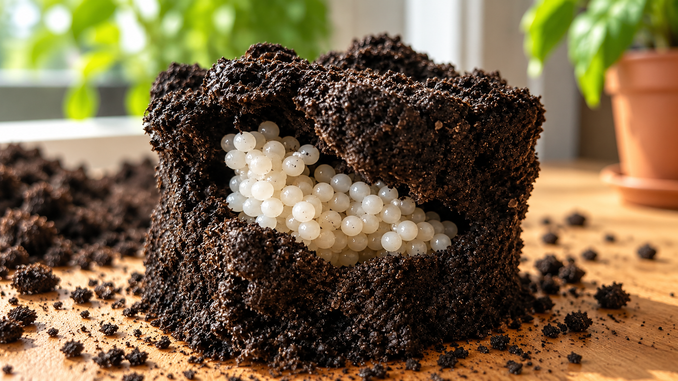
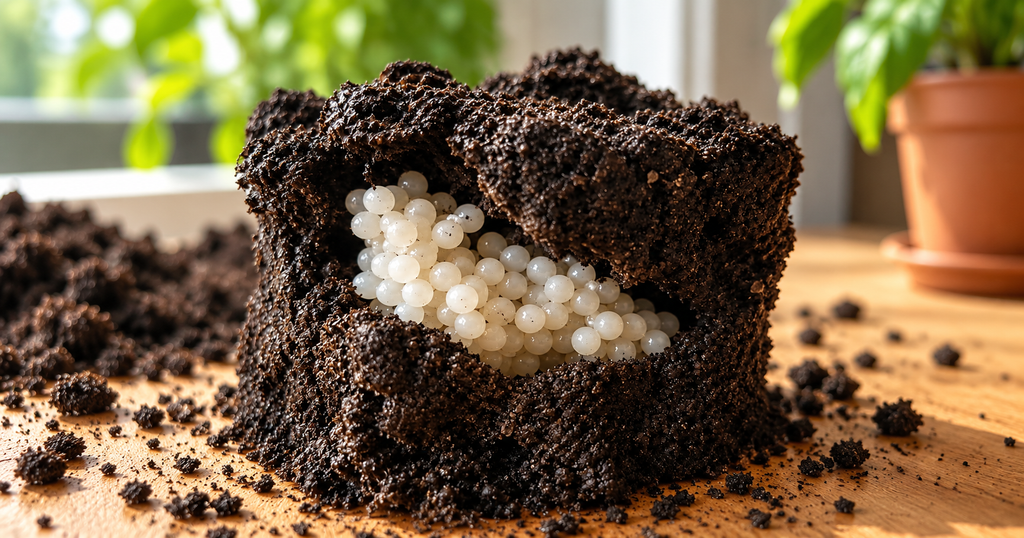
Instead, I found dozens of tiny white spheres beneath the soil.
They were clustered together several inches below the surface, almost perfectly round and pale enough to resemble miniature pearls. My first thought was that someone had spilled plastic beads there years earlier.
Then I touched one with my gardening glove.
It wasn’t hard.
The surface gave slightly beneath my finger and felt soft, almost gelatinous.
I immediately pulled my hand away.
A much less comfortable possibility entered my mind.
What if these were eggs?
And if they were, what had laid them?
The Discovery Beneath the Leaves
The strange cluster appeared near an old wooden border separating the flower bed from the lawn.
That section of the garden had been neglected for months. Fallen leaves had accumulated around the boards, and the soil underneath remained damp even when the rest of the yard was dry.
I was removing weeds when my small shovel exposed the first white sphere.
Then another appeared.
Then several more.
I stopped digging.
They were packed closely together in a shallow cavity.
Nothing moved.
I looked around for an adult animal but saw only worms, insects and the usual garden life.
My imagination, however, became considerably more dramatic.
Snake eggs?
Lizard eggs?
Some kind of insect nest?
I knew enough to understand that guessing based on appearance alone was unreliable.
So I stopped touching them.
Why Mystery Eggs Are Difficult to Identify
Many creatures lay eggs in or near soil, and several completely unrelated species can produce surprisingly similar-looking clusters.
Reptile eggs, for example, are often quite different from the rigid eggs people associate with birds. Depending on the species, they can have leathery or flexible shells.
Snails and slugs also deposit groups of pale, translucent eggs in protected, damp locations. Their eggs can resemble tiny pearls or beads and are often discovered under leaves, stones, logs, pots or within loose soil.
Some fungi and other natural structures can also be mistaken for eggs.
That means color and shape alone rarely provide enough information for confident identification.
Location, size, texture, number and surrounding habitat all matter.
The more I read, the more I realized that my mysterious discovery was probably less terrifying than my imagination suggested.
But I still wanted an answer.
The Snake Theory
Snakes were my first concern.
Our area had several native snake species, and I had occasionally seen harmless ones near the garden.
The thought of dozens of snakes emerging beside the house was not appealing.
Yet the evidence did not fit particularly well.
The spheres I found were extremely small.
They were also numerous and almost translucent when held against the light without being disturbed.
Snake eggs are generally much larger than the tiny pearl-like objects in front of me.
The cluster also lacked the elongated shape common in many reptile eggs.
That did not prove anything by itself, but it made the snake explanation increasingly unlikely.
I crossed it off my list.
Then I discovered a far more plausible candidate.
The Garden’s Nighttime Residents
I returned outside after sunset with a flashlight.
Within minutes, I noticed something I had largely ignored during the day.
Slugs.
Several were moving slowly across the damp soil near the flower bed.
A snail was attached to the underside of a planter.
Suddenly the location of the mysterious cluster made sense.
Snails and slugs seek protected, moist environments because their soft bodies are vulnerable to drying out. The same kinds of places can provide suitable conditions for their eggs.
The neglected corner of my garden offered exactly that.
Shade.
Moisture.
Loose soil.
Decaying plant material.
Protection beneath the wooden border.
I had accidentally uncovered what looked increasingly like a nursery.
The Identification
The next day, I photographed the cluster without moving it further and compared the details with reliable gardening and natural-history references.
The most likely explanation was far less frightening than snakes.
They were gastropod eggs—probably from a slug or snail species living in the garden.
The small size, rounded form, soft texture and damp underground location all supported that identification.
Without examining the animals themselves or obtaining an expert identification, determining the exact species from eggs alone would have been difficult.
But the broader mystery was solved.
The “pearls” were not jewelry.
They were not plastic.
And they were not evidence of some enormous unknown creature preparing to emerge beneath my flowers.
They were part of an ordinary biological cycle taking place a few steps from my back door.
Why There Were So Many
The number surprised me.
I had assumed an animal might lay three or four eggs at a time.
Many terrestrial gastropods, however, can lay clusters containing numerous eggs, and some species reproduce multiple times when environmental conditions are favorable.
A moist garden can therefore support a much larger population than a homeowner realizes.
Most of the activity happens quietly.
Slugs often feed at night.
Snails may hide during hot or dry periods.
Eggs remain beneath soil or debris.
You can spend years maintaining a garden without noticing much of this hidden life.
Then one afternoon, a shovel removes a thin layer of earth and suddenly an entire miniature world becomes visible.
Should Gardeners Destroy Them?
Once I knew what the cluster probably was, I faced another question.
What should I do with it?
The answer depends partly on context.
Snails and slugs are natural members of many ecosystems. They participate in decomposition and can serve as food for birds, amphibians, insects and other animals.
But some species can also become significant garden pests.
Young seedlings and tender leaves can be particularly vulnerable to feeding damage.
In some regions, invasive gastropod species create additional ecological or agricultural concerns.
Because I had not identified the exact species, I decided against randomly spreading or relocating the eggs elsewhere.
Moving unknown organisms can create problems, particularly if the species is invasive.
Instead, I took the opportunity to examine why that corner of the garden had become such an attractive habitat.
The Garden Had Been Giving Me Clues
Once I started paying attention, the signs were obvious.
Several young plants had irregular holes in their leaves.
A few seedlings had disappeared almost completely.
There were faint shiny trails across stones early in the morning.
I had blamed insects.
Some of that damage may indeed have come from insects, but the nighttime gastropods were almost certainly contributing.
The egg cluster was not an isolated mystery.
It was evidence of what had already been happening around me.
That changed how I approached the garden.
Rather than reaching immediately for chemicals, I began with environmental management.
I removed unnecessary boards and debris that created permanent damp hiding places.
I avoided leaving overturned containers directly on wet soil.
I watered plants earlier in the day where practical, allowing surface areas to become less inviting overnight.
I also started checking vulnerable plants after dark.
A Lesson in Garden Ecology
The experience made me think differently about the word “pest.”
Gardeners naturally organize living things according to whether they help or harm the plants we want to grow.
Bees are welcomed.
Aphids are not.
Earthworms are celebrated.
Slugs usually receive less affection.
Nature does not use those categories.
A slug eating lettuce may be a nuisance to the gardener, but it is also part of a food web.
A damp board that looks like rubbish to us can be shelter for multiple organisms.
Even a small suburban garden is not simply a decorative space under human control.
It is habitat.
That does not mean gardeners must surrender every vegetable to wildlife.
It means effective management begins with understanding what is actually present.
Why I Was So Alarmed
Looking back, my first reaction seems excessive.
The eggs were tiny.
Nothing threatened me.
Yet within minutes I had imagined dangerous animals living beneath my house.
Unfamiliar natural objects often trigger that reaction.
Humans are good at noticing patterns but not always good at interpreting them.
A strange cluster becomes “mysterious eggs.”
A harmless insect becomes “something poisonous.”
A fungus becomes evidence of an unknown creature.
The internet can amplify that tendency because the most frightening explanation is often more interesting than the ordinary one.
But extraordinary appearances frequently have ordinary biological explanations.
Careful observation is usually more useful than panic.
What Happened to the “Pearls”
I left part of the area undisturbed while continuing to observe it.
Over time, the original cluster changed.
Some eggs became more translucent.
Eventually the neat group I had discovered was gone.
The garden continued exactly as before.
Birds searched through the soil.
Beetles disappeared beneath leaves.
Snails emerged after rain.
My terrifying mystery had become ordinary nature again.
But I had changed.
I started looking more closely.
Under one flowerpot, I discovered a collection of tiny insects I had never noticed.
Beneath rotting wood, I found networks of fungal growth.
After rain, I began seeing animal tracks in the soft earth.
The garden had always contained these things.
I had simply been too focused on flowers and weeds to notice them.
A Small Discovery With a Useful Lesson
Finding those white spheres taught me something surprisingly valuable.
When you discover an unfamiliar object in nature, especially something that might be eggs, a nest or another living structure, the safest first response is usually simple: do not handle it unnecessarily.
Observe it.
Photograph it from a safe distance.
Consider the habitat.
Consult reliable local resources if identification matters.
And avoid relocating unknown organisms until you know what they are.
My discovery did not end with a dangerous animal bursting from the ground.
There was no hidden treasure either.
The truth was quieter.
A small creature had found a dark, moist corner of my garden and used it exactly as nature intended.
Those strange white “pearls” had frightened me because I did not understand them.
Once I did, they became something entirely different.
They were evidence that beneath the garden I thought I knew, another world had been living all along.
Отправить ответ