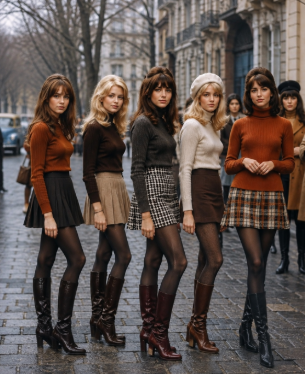
For decades, the photograph attracted almost no attention.
At first glance, there was nothing particularly mysterious about it. It looked exactly like the sort of family snapshot that could have been taken almost anywhere in the 1970s: slightly faded colors, clothing typical of the period, an ordinary background and people posing without the polished perfection expected from modern photographs.
There was no dramatic expression, no obvious accident and no reason to suspect that anything unusual had been captured.
Then someone enlarged the image.
Suddenly, an apparently insignificant detail became impossible to ignore.
Some viewers claimed they noticed it immediately. Others stared at the photograph repeatedly without understanding what everyone else was talking about. Once the unusual feature was pointed out, however, many people said they could no longer look at the picture in the same way.
But was the photograph really hiding something disturbing?
Or was the human brain doing what it does remarkably well—finding meaning in ambiguous visual information?
The answer is more interesting than any supernatural explanation.
An Ordinary Picture From Another Era
Old photographs have a distinctive atmosphere that modern digital images rarely reproduce.
Pictures from the 1970s were usually taken on film. Families did not immediately see the result after pressing the shutter button. A photograph might remain inside a camera for weeks before the film was developed.
There was no zooming in on a screen.
No instant cropping.
No image enhancement.
And certainly no opportunity to examine every corner of a photograph within seconds of taking it.
Most family pictures were printed relatively small and placed inside albums, boxes or frames. Tiny background details could easily remain unnoticed simply because nobody had any reason to study them.
That appears to be the essential idea behind the mysterious photograph.
Nothing about the original image demanded investigation. It was treated as an ordinary memory rather than evidence of an unexplained event.
Only much later, when photographs could be scanned, enlarged and shared online, did people begin examining images differently.
A detail that might have been only a few millimeters wide on a printed photograph could suddenly fill an entire computer screen.
And enlargement changes more than size.
It changes attention.
The Moment the Image Became a Puzzle
Once the photograph began circulating as a visual mystery, viewers were no longer looking at it naturally.
They had been given a challenge:
Something is wrong here.
Find it.
That instruction completely changes the way the brain processes an image.
Instead of seeing the photograph as a complete scene, viewers begin dividing it into sections. They inspect faces, hands, windows, shadows, reflections and objects in the background.
The process resembles solving a visual puzzle.
One person may become convinced that a shadow has an impossible shape. Another may focus on what appears to be a face. Someone else may notice an object that seems inconsistent with the period.
Soon the photograph stops being simply a photograph.
It becomes a test.
And this is where human perception becomes fascinating.
Why Some People See the Detail Immediately
Our eyes do not record the world like cameras.
The brain constantly interprets incomplete information. It identifies patterns, predicts shapes and fills gaps based on previous experience.
Most of the time, this ability is extremely useful.
If we see only part of a familiar object behind another object, we do not need to see every centimeter of it to understand what it probably is. The brain automatically reconstructs the missing information.
Faces are especially powerful.
Humans are extraordinarily sensitive to facial patterns. Two dark areas resembling eyes and another shape resembling a mouth can be enough for the brain to interpret random visual information as a face.
This phenomenon is commonly known as pareidolia.
It explains why people sometimes see faces in clouds, rock formations, tree trunks, electrical outlets or patterns on walls.
Old photographs provide ideal conditions for this kind of perception.
Film grain, faded colors, unusual shadows, damaged prints and low resolution can combine to produce shapes that appear far more meaningful than they actually are.
Once someone says, “There is a face in the background,” the effect becomes even stronger.
Now the viewer knows what to search for.
The Power of Suggestion
Imagine seeing the photograph without any introduction.
You might spend two seconds looking at it and move on.
Now imagine someone shows you exactly the same picture but says:
“Thousands of people were disturbed when they discovered what was hiding in this photograph.”
Your reaction changes immediately.
You expect something disturbing.
That expectation influences attention.
Dark areas suddenly seem suspicious. Reflections become important. Background figures receive more scrutiny than the people who were originally supposed to be the subject of the picture.
This does not mean viewers are foolish or imagining things deliberately.
It is simply how perception works.
Context affects interpretation.
A shadow in a normal family photograph is a shadow.
The same shadow in a photograph described as “unexplained” becomes potential evidence.
Why Old Pictures Feel More Mysterious
There is another reason photographs from previous decades are particularly effective at creating this reaction.
They already feel distant.
A picture from the 1970s belongs to a recognizable world, but one that is different enough from the present to create emotional distance. Hairstyles, furniture, wallpaper, cars and clothing remind us that the moment captured in the photograph is gone.
The people in the image are also frozen at an age they may no longer be—or may never be again.
That naturally gives old photographs a slightly haunting quality.
A digital photograph taken yesterday feels immediate.
A faded photograph discovered in a drawer feels like an artifact.
When an unexplained shape appears inside such an artifact, imagination has fertile ground.
Who took the photograph?
Who are the people?
Did they notice the strange detail?
Was somebody standing behind them?
Was the image altered?
Questions multiply faster than answers.
Could the Photograph Have Been Manipulated?
Whenever an old photograph becomes famous online because of an extraordinary detail, manipulation must be considered.
Digital editing has made alterations easier than ever, but photographic manipulation existed long before computers.
Images could be retouched, combined, double-exposed or physically modified.
However, unusual appearance alone is not evidence that manipulation occurred.
To determine whether an image has genuinely been altered, investigators would ideally need access to the original negative or the earliest known print. A heavily compressed copy downloaded from social media is far less useful.
Every time an image is copied, resized, sharpened or compressed, visual artifacts can appear.
Edges become strange.
Pixels blend together.
Dark regions lose information.
Objects that were originally recognizable may become ambiguous.
Ironically, repeatedly sharing an image can make it look more mysterious.
A Detail Without a Verified History
The short description attached to this particular story does not provide enough verifiable information to establish the photograph’s original owner, exact date, location or photographer.
That distinction matters.
Without documented provenance, it would be irresponsible to claim that the image records a supernatural event, an unknown person or some historically impossible object.
A compelling visual mystery is not automatically evidence.
It is perfectly reasonable to enjoy such photographs as puzzles while remaining cautious about the stories attached to them.
Online images often become separated from their original context.
One person posts a photograph with a question.
Another adds an interpretation.
A third person repeats that interpretation as fact.
Years later, the story surrounding the image may be far more elaborate than anything known about the original photograph.
The mystery grows through repetition.
The “Once You See It” Effect
Perhaps the most interesting part of these photographs is what happens after somebody finally identifies the supposedly strange feature.
Before that moment, the detail may be almost invisible.
Afterward, it becomes dominant.
You wonder how you missed it.
Psychology offers a simple explanation.
Once the brain has successfully organized ambiguous shapes into a recognizable pattern, it becomes difficult to return to the earlier interpretation.
Consider a drawing that can be interpreted as two different objects. At first, you may see only one. Once someone explains the second interpretation, switching between them becomes easy.
The pixels have not changed.
Your perception has.
That is why visual mysteries often produce comments such as:
“I didn’t see anything for five minutes, and now it’s all I can see.”
The experience feels dramatic because the transformation happens inside the observer rather than inside the photograph.
Social Media Made Old Mysteries New Again
Photographs once lived mostly private lives.
They remained inside albums and were shown to relatives or friends.
The internet completely changed that.
An anonymous family photograph can now be seen by millions of strangers. Each viewer can enlarge it, adjust brightness, crop sections and offer a theory.
One photograph can therefore generate dozens of competing explanations.
Someone sees a hidden person.
Another sees an animal.
A third believes the mysterious shape is simply clothing hanging in the background.
Someone enhances the image and becomes even more convinced of a dramatic explanation.
Another points out that enhancement software can introduce misleading details.
The debate itself then becomes part of the photograph’s identity.
Eventually, people share it not because they know its history but because they want to see whether their friends can find the mysterious detail.
What We Should Really Look For
The temptation with mysterious photographs is to search immediately for the most extraordinary explanation.
A better approach is to begin with ordinary possibilities.
Could the shape be a person standing farther away than expected?
Could two overlapping objects create the illusion of a face?
Could a reflection be responsible?
Could motion blur have distorted someone?
Could the original photograph have been scratched or damaged?
Could digital compression have changed the appearance?
Only after simpler explanations have been considered does it make sense to entertain more unusual possibilities.
That approach may sound less exciting, but it often makes the photograph more interesting.
Instead of asking only, “What is hiding there?” we begin asking a deeper question:
“Why does my brain interpret this collection of shapes in that particular way?”
The Real Mystery May Be in the Viewer
The famous appeal of the old photograph ultimately comes from uncertainty.
Something seems wrong.
We look again.
Perhaps we find it.
Perhaps we do not.
Then someone points toward a particular corner, shadow or figure, and suddenly the entire picture changes.
Yet the photograph itself has remained exactly the same.
That may be the most remarkable part of the story.
An ordinary image can spend decades unnoticed before technology, curiosity and human perception transform it into a mystery. Enlargement reveals details that small prints concealed. Suggestion directs our attention. Pattern recognition turns uncertain shapes into familiar forms. Social media then allows thousands of people to compare what they believe they see.
Without access to a documented original and reliable information about its history, dramatic claims about the photograph should remain exactly what they are: interpretations rather than established facts.
But that does not make the picture meaningless.
Quite the opposite.
It demonstrates something extraordinary about the way we see.
Sometimes the strangest thing hidden inside an old photograph is not a ghost, an impossible object or an unknown figure.
Sometimes it is simply the enormous difference between looking at something and truly noticing it.
Отправить ответ