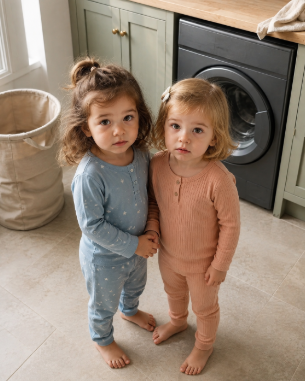
A fictional story.
Before Daniel called the woman who had sold him the washing machine, he put every banknote back in the box.
He had counted them twice. One hundred and sixty dollars, exactly what he had paid her that morning. Beneath the money lay a grocery gift card marked two hundred dollars. On top was a folded note.
“For you and your children. — M.”
From the hallway, his six-year-old daughter called to ask whether her school cardigan would be dry by morning. Her twin brother had borrowed it to wrap a stuffed rabbit, and now both cardigan and rabbit smelled faintly of orange juice.
“We’ll work something out,” Daniel answered.
It was becoming the sentence he used for everything.
For eighteen months, there had been three of them at the kitchen table. Daniel had learned to tie a respectable ponytail, divide the last banana without starting an argument, and sign school forms while making breakfast. What he had not learned was how to make his wages stretch around every unexpected expense.
The washing machine had failed three weeks earlier.
Since then, he had washed small things in the bathtub and taken heavier loads to the laundromat after work. On those evenings, Lily and Owen ate sandwiches beside him while their clothes turned behind the glass. They thought the dryers looked like spaceships. Daniel watched the money disappear into the machines.
When he found a used washer advertised nearby, he messaged the seller to ask whether he could bring his twins when collecting it.
The seller, Miriam, was moving into a smaller place closer to her son. Her listing said the machine had been reliable and that the buyer would need to collect it.
Daniel borrowed his neighbor’s van. He brought the twins because there was nobody available to watch them that morning.
At Miriam’s house, Owen announced that they were buying a washing machine so his father could stop hanging socks over the bathroom door.
“They fall on your head,” he explained solemnly.
Miriam smiled. She asked the children their names and gave them paper and pencils at the kitchen table while Daniel and his neighbor loaded the machine.
Before leaving, Daniel counted the money into her hand.
“I put the instruction booklet in the drum,” she said. “Safe journey home.”
An hour later, the washer stood in his kitchen. Daniel connected it, checked the hose, and selected a short spin before fetching the laundry.
The pump made a noise. The drum remained still.
He tried once more, then switched the machine off and unplugged it. For a moment he simply stood there, holding the plug. The borrowed van had already gone. He could not afford another machine, and he had no idea what a repair might cost.
He opened the door to retrieve the booklet. Behind it, tucked inside a folded packing cloth, was a small plastic box.
Now it sat beside his phone.
When Miriam answered, Daniel had his explanation ready.
“I found something you left inside. Some money. I can bring it back tomorrow.”
“Did you read the note?”
“Yes, but I thought—”
“Then it reached the right person.”
“You don’t know us,” Daniel said.
“I know you bought a washing machine. I know you’ve got two children. That’s enough for a grocery card.”
He rubbed a thumb over the edge of the box.
“I wasn’t asking for help.”
“I know.”
Her answer was so matter-of-fact that he could find nothing to argue with.
Then she asked whether he had managed to get the machine running.
Daniel hesitated. Complaining about the washer suddenly felt ungrateful. He had been ready to return the money and demand his payment back; now he could barely explain that the drum would not turn.
Miriam listened without interrupting.
“The money was supposed to be there,” she said. “The problem with the machine wasn’t.”
“Maybe I’ve done something wrong.”
“Maybe. Maybe something came loose in the van. Let’s find out before either of us takes the blame.”
She asked him to leave it unplugged while she contacted the repair shop she had used for years. Daniel began to protest, but she stopped him gently.
“I advertised a working machine. You’re allowed to tell me if it doesn’t work.”
The repairer came the following afternoon. After checking the washer, he found that its drive belt had come off. He fitted a replacement and tested it through a cycle. Miriam had arranged to cover the bill.
Daniel watched the drum begin to turn. He felt such relief at the ordinary sound that he had to busy himself collecting towels.
That evening, he called Miriam again.
“It’s working,” he said. “And I want to pay you back. Perhaps not all at once.”
“There’s nothing to pay back.”
He went quiet.
After a moment she told him about a winter when her own son was small. She had been raising him alone and working in a bakery. Her hours had been reduced just as he needed a new pair of school shoes.
An older colleague had bought the shoes and left them in her locker. Miriam had tried to repay her every Friday for a month.
“She finally asked whether I would please let her finish doing something nice,” Miriam said.
Daniel laughed, reluctantly.
“Did you?”
“Eventually. I was quite stubborn.”
He had spent the day calculating which extra shifts could settle the debt. Miriam had given him no deadline; he had supplied one himself.
“The card is for whatever you need,” she added. “You don’t have to report back.”
Two days later, Daniel bought washing powder, fruit, eggs, bread for the freezer, and the cereal the twins had stopped asking for because he always said it was too expensive.
At the checkout, the gift card covered the groceries. His own money stayed in his account.
There would still be rent to pay. His work schedule would still collide with school holidays. Three hundred and sixty dollars had not rearranged his life into something easy. But he could replace Lily’s splitting shoes before rain got through them, and he no longer needed to spend Saturday evening at the laundromat.
That Saturday, the three of them made pancakes. Owen dropped an egg on the floor. Lily insisted hers should be shaped like a cat, then generously accepted something closer to a potato.
The washing machine ran beneath their laughter.
A week later, the twins drew Miriam a thank-you card. Owen’s picture showed a giant washing machine with three smiling people inside it. Daniel suggested moving them outside. Owen declined on artistic grounds.
Daniel added a few lines of his own. He thanked her for the machine, the groceries, and the way she had allowed him to mention the fault without making him feel ashamed.
Before sealing the envelope, he nearly wrote another promise to repay her. Instead, he crossed out the unfinished sentence and wrote that they had spent Saturday morning together at home.
Miriam’s reply arrived four days later. Inside was a pancake recipe with a note that her son had preferred his shaped like dinosaurs, although hers had usually resembled potatoes too.
Daniel pinned it to the refrigerator.
Отправить ответ