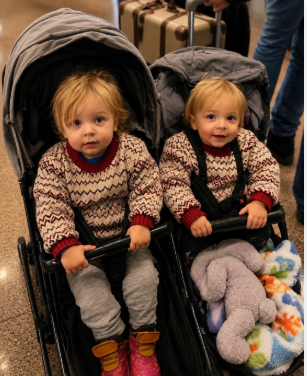
The family vacation was supposed to begin the moment they reached the airport.
After months of planning, Eric and Laura were finally taking their 18-month-old twins to Florida. They had imagined warm weather, mornings near the water and a few precious days away from work, household chores and ordinary routines.
Getting there, however, was going to require teamwork.
They had two toddlers, a double stroller, suitcases, diaper bags, car seats and enough snacks to survive several unexpected delays. Simply moving from the parking area to the terminal felt like a complicated operation.
Laura was tired before they even reached the gate, but she was not particularly worried. Eric was there. They would divide the work, take turns entertaining the children and somehow make it through the flight.
Then Eric looked at his phone.
A smile appeared on his face.
“I got upgraded.”
Laura initially thought he meant both of them.
He didn’t.
One first-class seat had become available, and Eric intended to take it.
He handed her one of the bags, glanced toward their restless twins and said something she would remember long after the vacation ended.
“You’ll manage, right?”
Then he walked toward the front of the aircraft.
The Difference Between Traveling and Traveling With Toddlers
Anyone who has flown with very young children knows that the experience bears little resemblance to ordinary air travel.
Adults can wait through a delay while reading a book or looking at a phone. Toddlers have no understanding of boarding schedules, security procedures or why they are expected to remain still when every instinct tells them to explore.
At 18 months, the twins needed almost constant attention.
One wanted to walk whenever he was supposed to sit.
The other became upset when strangers came too close.
There were bottles to prepare, diapers to change and toys that repeatedly fell onto the floor.
Laura had expected all of this.
What she had not expected was doing it alone while her husband relaxed several rows away.
The issue was not that Eric had received an upgrade.
The problem was what he decided the upgrade meant.
He saw an opportunity for personal comfort.
Laura saw the disappearance of her partner exactly when she needed him.
“You’ll Manage”
Those two words followed her through the boarding process.
Of course she could manage.
Parents manage difficult situations every day.
They prepare meals while holding children. They function after sleepless nights. They carry groceries, answer emails, clean messes and solve problems simultaneously.
But being capable of doing something does not mean it is reasonable to expect one person to do it alone.
That distinction was what bothered Laura.
Eric had not asked, “Would you mind if I took the upgrade?”
He had not suggested switching seats halfway through the flight.
He had simply assumed that because Laura was capable of handling the twins, she should handle them.
Competence had quietly become an excuse to give her more work.
Boarding Became the First Test
Laura folded the stroller at the aircraft door while trying to keep both toddlers close.
One twin began crying.
The other dropped a stuffed animal.
A flight attendant helped retrieve it while another passenger waited patiently behind them.
Laura apologized repeatedly.
“You don’t need to apologize,” the passenger told her.
That simple sentence nearly made her cry.
She finally reached their seats and began arranging everything they would need during the flight.
Wipes.
Snacks.
Bottles.
Toys.
Extra clothes.
The diaper bag had to remain accessible while the larger items were stored.
Several rows ahead, beyond the curtain separating the cabins, Eric was already sitting down.
Laura could not see him.
That somehow made the situation worse.
The Woman Across the Aisle
Once everyone was seated, an older woman across the aisle introduced herself as Helen.
She watched Laura struggle to keep one twin occupied while fastening the other into place.
“Would you like me to hold that bag?”
Laura hesitated.
She was accustomed to saying no automatically.
Then she looked at everything surrounding her.
“Yes. Thank you.”
Helen held the diaper bag while Laura settled the children.
It was a tiny favor.
But it was the first of several.
During takeoff, one twin became frightened by the noise. Laura comforted him while trying to stop his sibling from throwing a toy beneath the seat.
Helen picked up the toy.
Later, she passed Laura a packet of wipes before Laura even asked.
At one point, when both children were crying simultaneously, another passenger smiled at Laura instead of glaring.
The flight attendants checked on her whenever they passed.
None of these people was responsible for helping her.
That was precisely what made their kindness so noticeable.
The person who was responsible for sharing the work was sitting in first class.
What Was Happening Behind the Curtain
Eric, meanwhile, was enjoying an entirely different journey.
His seat was wider.
He had more legroom.
He was offered a drink before departure.
There was no stroller to fold, no toddler attempting to climb onto his lap and no bag filled with emergency clothes beneath his feet.
For the first hour, he convinced himself that Laura was probably fine.
After all, she handled the twins by herself at home sometimes.
But that comparison ignored something important.
At home, she was not trapped inside an aircraft.
At home, there was room to move, familiar routines and everything the children needed nearby.
And most importantly, this was supposed to be a family trip.
Eric had not been unavailable because of work or an emergency.
He was sitting only a short distance away because he had chosen a better seat.
The Moment Laura Stopped Making Excuses for Him
Halfway through the flight, one of the twins needed a diaper change.
Laura carried him toward the restroom while Helen agreed to watch the other child for the few minutes she would be away.
On her way back, Laura saw Eric.
The curtain was partially open.
He was wearing headphones.
A drink sat beside him.
He looked completely relaxed.
Something shifted inside her.
Until then, she had been angry about the practical problem.
Now she understood that the real problem was larger.
Eric knew she was struggling.
He simply believed his comfort mattered more.
Laura returned to her seat without confronting him.
The airplane was not the place for the conversation they needed to have.
But she stopped telling herself that the situation was merely annoying.
It was revealing.
The Unexpected Announcement
Not long afterward, a flight attendant approached Laura.
“Your husband asked whether everything is okay.”
Laura looked at her.
For a moment, she almost laughed.
“He could come back here and find out.”
The flight attendant’s expression remained professional, but something in her eyes suggested understanding.
Several minutes later, Eric appeared in the aisle.
He seemed surprised by the chaos surrounding Laura’s seat.
One child was asleep awkwardly against her shoulder.
The other had spilled part of a snack.
Toys were scattered across the small space.
Laura looked exhausted.
Eric lowered his voice.
“Do you need help?”
It was an astonishing question.
Laura stared at him.
“They’re your children too.”
The sentence was quiet.
It did not need to be louder.
The Seat He Finally Gave Up
Eric stood there for several seconds.
Perhaps he had expected Laura to say she was fine.
Perhaps he expected to help for ten minutes and return to first class.
Instead, he looked at the sleeping child against her shoulder and then at Helen, a complete stranger who had been assisting his wife.
That seemed to embarrass him more than anger would have.
He returned to the front of the plane.
A few minutes later, he came back carrying his belongings.
He had given up the first-class seat.
Whether another passenger received the upgrade no longer mattered.
Eric took responsibility for one twin and remained with the family for the rest of the flight.
Laura did not congratulate him.
Doing his share was not an extraordinary act deserving applause.
It was what should have happened from the beginning.
The Conversation in Florida
Their arrival did not magically resolve the conflict.
Once they reached their accommodation and the twins were asleep, Laura finally told Eric why the incident had upset her so deeply.
It was not about first class.
If he had been traveling alone, she would have been happy for him.
It was about partnership.
“You looked at everything I was carrying and decided it was still okay to leave,” she told him.
Eric initially defended himself.
He said he had assumed she could manage.
Laura agreed.
“I could. That’s not the point.”
That became the most important part of the conversation.
In many relationships, the more capable partner gradually becomes responsible for more tasks precisely because they can handle them.
One person remembers appointments, packs bags, anticipates what children will need, organizes meals and solves small emergencies.
Eventually, the other person begins treating that labor as something that simply happens.
But invisible work is still work.
Why Unequal Parenting Creates Resentment
Parenting is not only a collection of visible tasks.
There is also the mental work behind those tasks.
Someone has to remember that diapers are running low.
Someone has to know which bag contains medicine.
Someone has to anticipate that a toddler may need food before becoming hungry enough to have a meltdown.
This constant planning is sometimes described as the mental load.
Problems arise when one parent becomes the default manager while the other behaves more like an assistant waiting to be assigned tasks.
A true partnership requires more than helping when asked.
It requires noticing what needs to be done.
Eric’s mistake at the airport was a particularly obvious version of a problem that can appear in much smaller ways every day.
He had looked at the situation and asked whether Laura could cope.
A better question would have been:
Why should she have to cope alone when I’m right here?
The Vacation Changed After That Flight
The rest of the Florida trip became unexpectedly important for their relationship.
Eric began paying closer attention to responsibilities he had previously assumed Laura would handle.
He packed the diaper bag before outings.
He took one twin back to the room when the child became tired.
He handled breakfast while Laura had time alone.
These were not heroic gestures.
They were ordinary acts of parenting.
That was precisely the point.
Laura did not need grand apologies or expensive gifts.
She needed a partner who understood that raising their children belonged equally to both of them.
The first-class incident became an uncomfortable but useful lesson.
Sometimes resentment does not begin because one person is incapable of helping.
It begins because that person waits until the other is overwhelmed before recognizing that help was needed.
The Upgrade That Cost More Than Expected
On the return flight, there was another opportunity for an upgrade.
This time, Eric was offered a single premium seat at check-in.
He declined it immediately.
Laura noticed.
Neither of them made a joke about the previous flight.
They simply boarded together.
Eric carried the car seats.
Laura pushed the stroller.
They each took responsibility for one twin.
The journey was still tiring. One child cried during boarding, and the other refused to sleep when everyone desperately wanted him to.
Nothing about traveling with toddlers had suddenly become easy.
But difficulty feels different when it is shared.
That was the lesson hidden inside a seemingly small decision at an airport.
Eric had believed a first-class upgrade was simply a lucky opportunity.
Instead, it exposed an imbalance he had failed to recognize.
Laura had always been capable of managing.
She was capable of carrying the bags.
Capable of calming both children.
Capable of solving the problems.
But love is not demonstrated by discovering how much your partner can endure without you.
Partnership means looking at the burden before they have to ask and taking your share of it.
The best seat on that first flight had been several rows ahead.
Eric eventually discovered that it was also the loneliest place he could have chosen on a family vacation.
Отправить ответ