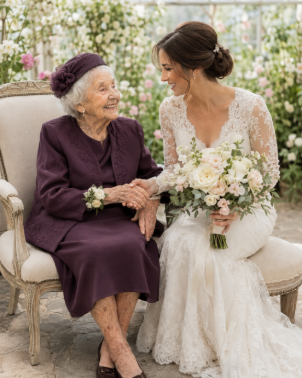
When the vicar acknowledged another special occasion during a wedding celebration, Martha Wallbank raised her hand. She knew exactly whose day it was. Her granddaughter was getting married, and Martha was turning one hundred.
The wedding of Vita Cresswell and Gary Whineray took place on April 8, 2016. Martha attended as a bridesmaid. According to Vita’s account to Inside Edition, the guests sang happy birthday, and her grandmother joined in, waving and clapping for herself.
There is something especially moving about that image: a woman celebrating her own life while the people around her celebrate a new marriage. Neither occasion has to disappear into the other. One family has found room for both.
The decision to make Martha a bridesmaid had begun with Martha herself. As Vita recalled in her interview, they were discussing wedding plans over a game of Scrabble when her grandmother asked, “Am I a bridesmaid?” Vita and Gary agreed. )
That question gives Martha a voice in her own story. She wanted to participate and said so. Her granddaughter listened. The affection was mutual, expressed through an ordinary conversation that changed the shape of an important day.
It is easy to imagine a bridal party through a narrow set of expectations: friends of roughly the same age, similar outfits, and familiar duties. Yet the people who have helped someone grow up rarely fit into such a neat arrangement. A wedding can acknowledge those relationships without requiring everyone to belong to the same generation.
Later coverage by AmoMama described Martha’s long involvement in the family. She had raised Vita’s mother, Veronica, as a single parent and reportedly worked three jobs to support her. Vita and her siblings had also received their grandmother’s care during childhood. The account described a close relationship sustained through time spent together.
Those details give the bridesmaid role a meaning beyond its novelty. Being included in a wedding can recognize years of care that never had an audience. Family relationships are often built through repeated, unremarkable acts: making time, listening, providing help, and being available again the following week. A public celebration offers a chance to acknowledge what has quietly mattered for years.
That does not mean affection must be repaid with an elaborate gesture. Care is not an invoice, and a wedding cannot settle a lifetime of gratitude. But a role chosen thoughtfully can make appreciation visible. It tells the wider family which relationships the couple wants to carry into their married life.
Martha’s involvement extended beyond appearing in photographs. AmoMama’s account reported that she selected the hymns and the meal after the ceremony. It also described her wedding outfit: a cream coat and a pale blue hat decorated with lace and feathers.
Helping choose music or food is a different kind of recognition from receiving a mention in a speech. It allows someone’s preferences to influence the occasion. A person becomes part of the planning, with opinions that have consequences, rather than simply arriving to discover what everyone else has decided.
This is a useful distinction for any family hoping to include an older relative. Asking what someone would enjoy can reveal more than making assumptions about what would look touching. Perhaps they want a formal role. Perhaps they would rather help select a reading, share a recipe, or spend a quiet hour with the couple before the guests arrive. The invitation matters most when there is room for an honest answer.
For Vita and Gary, the shared date had a particular reason. Vita told Inside Edition that her grandmother had wanted to see them marry, and that choosing Martha’s birthday made sense to them.
A birthday already carries a family’s history. Attaching a wedding anniversary to it adds another reason to remember the date. There is a certain generosity in that decision: the couple’s new beginning becomes connected to someone whose place in their lives was established long before the wedding was planned.
Sharing an occasion can also require care. A milestone birthday should not become a passing announcement squeezed between wedding speeches. FOX 5 New York reported that the celebration included a birthday cake for Martha as well as the wedding cake.
That small, concrete detail says more than a grand claim that everyone had an unforgettable time. Two cakes acknowledge two occasions. The grandmother’s birthday retains its own place, even within a day full of vows, photographs, and congratulations for the newlyweds.
There is no reason to measure such a celebration by how many guests cried. Tears may accompany happiness, but they are not evidence that one family loves more deeply than another. Laughter, singing, conversation, and a person’s evident enjoyment can carry just as much feeling. An emotional story does not need every witness to respond in the same way.
Nor should Martha’s age become the only interesting thing about her. Reaching one hundred is remarkable, but a number cannot explain a person’s temperament, relationships, or wishes. The most revealing detail remains her willingness to ask for a part in the wedding. She had an idea about where she belonged and felt able to express it.
For couples considering something similar, affection works best alongside practical planning. A meaningful role should fit the person rather than force the person to meet a standard list of duties. Comfortable seating, manageable travel, time to rest, and clear arrangements can help someone enjoy the day. These are general considerations, not documented details of Martha’s wedding experience.
The same thoughtfulness includes accepting limits without turning them into a disappointment. Someone can be an honored member of a bridal party without standing for long periods, attending every gathering, or staying until the final dance. Participation should not become a test of stamina. What gives the role value is the relationship it represents.
And for a family whose older relative dislikes attention, a smaller gesture may be kinder. A private thank-you, a place nearby during the ceremony, or time reserved for conversation may mean more than a public announcement. The lesson is to notice the individual, not to reproduce someone else’s photograph.
The appeal of Vita and Martha’s story lies in the way a familiar celebration made space for an existing bond. Weddings naturally focus on the future: the promises a couple makes and the life they hope to build. Including a grandparent so fully can also acknowledge the relationships that helped bring them to that moment.
A hundredth birthday invites reflection on a long life. A wedding creates anticipation. Together, they allow a family to look in both directions while enjoying the people who are there now.
Отправить ответ