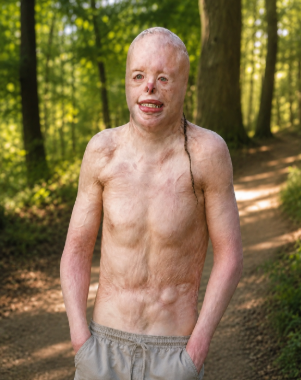
At four years old, a child should be discovering the world through games, questions and ordinary family routines. The future should feel limitless precisely because it has barely begun.
But sometimes a single event divides life into two parts: everything that came before it and everything that followed.
For one young child, that dividing line was a devastating fire.
The burns were catastrophic, reportedly affecting approximately 95 percent of the body. Survival itself became the first battle. Yet surviving the initial injuries was only the beginning. There would also be physical recovery, repeated encounters with doctors and hospitals, reactions from strangers and the far more complicated challenge of growing up in a world that often judges people within seconds of seeing them.
It would have been understandable to retreat.
Instead, the child grew into someone determined to participate in life rather than simply observe it from a distance.
This is not a story about pretending that severe trauma has no consequences. It is about something more realistic and more meaningful: learning that a life can be permanently changed without being permanently defined by the worst thing that happened to it.
The Day Childhood Changed
Severe burns are among the most complex injuries a person can experience. When a very large percentage of the body is affected, the immediate medical dangers can be enormous.
The skin is not merely the body’s outer covering. It helps protect against infection, regulate temperature and prevent excessive fluid loss. Extensive damage therefore affects far more than appearance.
For a four-year-old child, the situation is particularly serious.
The material on which this story is based does not provide enough verified information about the exact circumstances of the fire, the location, the medical treatment or the individual’s identity. Those details should not be invented.
What is presented as central to the story is that the fire caused severe burns over roughly 95 percent of the child’s body and permanently altered their appearance.
From that moment, recovery would mean far more than leaving a hospital.
Survival Is Only the First Chapter
When people hear that someone survived catastrophic burns, the word «survivor» can make the story sound as though the most difficult moment ended when the immediate danger passed.
In reality, major burn injuries can involve a long and demanding recovery.
Depending on the nature and depth of the burns, treatment may include wound care, surgery, skin grafting, rehabilitation and procedures intended to preserve movement and function. Scar tissue can tighten as it develops, sometimes affecting mobility and making physical therapy especially important.
Pain may continue long after the original emergency.
For a child, there is another dimension.
The body is still growing.
That means treatment and rehabilitation may accompany important stages of development. Medical procedures can become part of childhood rather than a temporary interruption to it.
There are also psychological challenges. A child recovering from severe burns may have to process fear, painful memories and changes in appearance before having the emotional vocabulary to explain any of them.
And eventually comes another challenge that no surgeon can completely solve:
returning to other people.
When Other People’s Eyes Become Part of Recovery
Visible differences often attract attention.
Sometimes people stare because they are curious. Sometimes they look away because they feel uncomfortable and do not know how to react. Children may ask direct questions. Adults may whisper. Others may make assumptions about a person’s abilities, personality or quality of life simply because of appearance.
None of these reactions necessarily reveals anything meaningful about the person being observed.
Yet repeated often enough, they can become exhausting.
For someone with extensive burn scars, entering a classroom, restaurant, workplace or social gathering can therefore require a kind of courage that other people never have to consider.
There is a fundamental difference between being seen and being known.
A stranger may notice scars immediately.
What the stranger cannot see is intelligence, humor, ambition, patience, curiosity, kindness, frustration, talent or determination.
Those things require conversation.
The person at the center of this story apparently made an important choice while growing up: rather than allowing other people’s reactions to determine the boundaries of life, they continued moving toward education, relationships and independence.
Education as a Way Forward
Going to school after a life-altering injury is not simply about completing lessons.
Education can restore something trauma often threatens to take away: a sense of future.
A hospital is organized around what has happened to the body. A classroom asks a different question:
What can you become?
That distinction matters.
Learning creates goals unrelated to injury. Mathematics does not care about scars. A book does not change its words depending on who opens it. Knowledge can provide an identity that exists independently of physical appearance.
Education also creates opportunities for social contact.
That can be difficult at first. Meeting unfamiliar people means confronting unfamiliar reactions. There may be questions, awkward moments and occasional cruelty.
But isolation has a cost too.
Avoiding every uncomfortable encounter may provide short-term protection while gradually shrinking the world.
By continuing to study and meet people, the individual in this story did something significant: life was allowed to become larger than the fire.
The Difference Between Resilience and Invulnerability
Stories about people who survive extraordinary circumstances are often described with words such as «strong,» «brave» or «inspirational.»
Those descriptions can be sincere, but they sometimes create a misleading picture.
Resilience does not mean never suffering.
It does not mean waking up every morning feeling confident.
It does not mean being unaffected by cruel remarks or never becoming tired of being stared at.
A resilient person can still experience fear.
A strong person can still need help.
Someone who has accepted their appearance can still have difficult days.
Real resilience is often much less dramatic than popular stories suggest.
It can mean attending class despite anxiety.
It can mean answering a stranger’s question for the hundredth time.
It can mean going outside when staying home would feel easier.
It can mean returning to rehabilitation after a painful session.
Sometimes resilience is simply deciding that yesterday’s difficulty will not automatically determine today’s decision.
Building Relationships After Trauma
One of the most important details in the original account is that the survivor continued meeting new people.
That may sound ordinary.
It is not.
Human relationships depend on vulnerability. Friendship requires allowing others close enough to know us. Love requires an even greater willingness to risk rejection.
Visible scars can complicate that process because appearance enters the interaction before personality has a chance to speak.
But relationships can also challenge the assumptions created by first impressions.
The longer people know one another, the less dominant physical differences often become. The scar that seemed impossible not to notice during the first meeting can eventually become only one characteristic among hundreds.
A person’s voice becomes familiar.
Their jokes become familiar.
Their habits become familiar.
Their values become familiar.
That is one reason genuine inclusion matters so much. People should not be reduced to whatever feature strangers notice first.
Appearance Is Information, Not Identity
Modern culture places enormous value on physical appearance.
Advertising promises transformation. Social media encourages carefully controlled images. Filters can alter faces within seconds. People are routinely evaluated according to standards that are narrow, unstable and frequently unrealistic.
In that environment, someone with extensive visible scarring can unintentionally challenge deeply rooted assumptions.
What makes someone attractive?
What makes a person worthy of attention?
What qualifies as a successful life?
If appearance determined destiny, the future of a severely burned four-year-old would have been decided on the day of the accident.
But human lives are not that simple.
A body can carry visible evidence of trauma while the person inside it continues learning, developing relationships, making decisions and creating plans.
Scars describe something that happened.
They do not describe everything that can happen afterward.
The Danger of Turning Survivors Into Symbols
There is another important lesson in stories like this.
People with visible differences should not be expected to inspire others simply by existing.
They are individuals, not motivational objects.
A burn survivor should be allowed to have ordinary ambitions, ordinary complaints and ordinary bad days without being required to demonstrate extraordinary courage at every moment.
Respect means recognizing the achievement without reducing the individual to the injury.
The fire may be an important part of the person’s history.
It is not necessarily the most interesting thing about them.
That distinction is crucial.
When society treats someone exclusively as «the burn survivor,» it can unintentionally repeat the same mistake as those who stare: focusing on the body before seeing the whole person.
What Really Gives Someone Strength?
The original account raises an intriguing question: what gave this person the strength to continue?
Without reliable biographical information, there is no responsible way to provide a specific answer.
Strength after severe trauma rarely comes from a single source anyway.
It may come from family support, medical professionals, teachers, friendships, personal goals, faith, community, therapy or the gradual discovery that difficult experiences can be survived one day at a time.
Often, strength is not something a person possesses fully formed.
It develops through repetition.
You face one difficult situation.
Then another.
You discover that fear does not always have to control action.
Over time, experiences that once seemed impossible become part of ordinary life.
A Future That the Fire Could Not Choose
The most powerful part of this story is not the severity of the injuries.
It is what happened afterward.
The child who suffered devastating burns grew older.
There was education.
There were new people.
There were choices.
There was a future constructed beyond the expectations others might have placed on someone with such visible injuries.
That does not erase the fire or minimize its consequences. Severe burns can leave permanent physical and emotional effects, and no uplifting conclusion should pretend otherwise.
The deeper message is that permanent change and permanent limitation are not the same thing.
A scar can remain for life without controlling every part of that life.
Other people may stare, but their reaction does not determine a person’s intelligence.
They may make assumptions, but those assumptions do not establish someone’s potential.
They may see the evidence of one terrible day before they see anything else.
But a human life contains thousands of days.
The fire happened when this child was four.
It changed the body forever.
What it could not do was write every chapter that followed.
And perhaps that is the most important distinction of all: we cannot always choose what leaves a mark on us, but those marks do not automatically get to choose who we become.
Отправить ответ