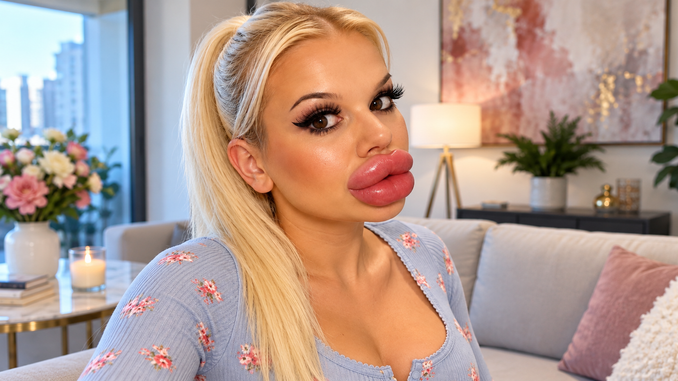
The first photograph could easily be mistaken for an entirely different person.
In it, a young woman has a natural face, understated makeup and none of the exaggerated features that would later make her appearance attract attention online. In more recent images, her lips appear dramatically fuller, her cheekbones more pronounced, and carefully applied makeup completes the doll-like aesthetic she spent years pursuing.
Her transformation did not happen overnight.
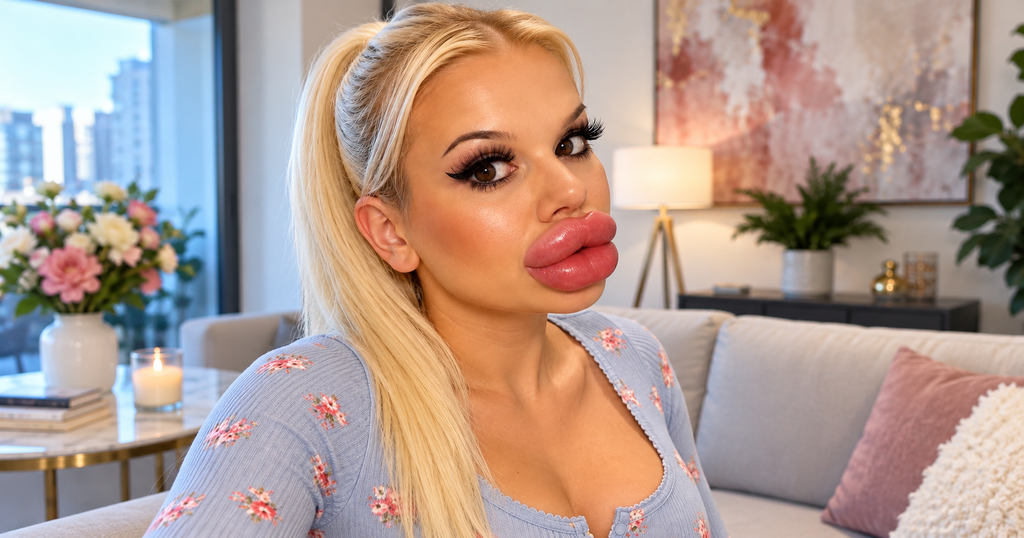
According to the story attached to the images, the changes developed over roughly five years and involved close to $10,000 in cosmetic treatments. But without a verified identity or reliable documentation, the exact procedures, cost and timeline should be treated as claims rather than established facts.
What the photographs do illustrate clearly is a much broader modern phenomenon: people increasingly have the ability to reshape their appearance to match an image they once could only imagine.
And that raises a complicated question.
What happens when changing your face becomes an ongoing project rather than a single decision?
The Dream of Becoming a “Living Doll”
The idea of resembling a doll is not new.
For decades, dolls have represented a highly stylized version of human beauty: large eyes, smooth skin, small noses, prominent cheekbones and carefully proportioned features.
Social media gave this aesthetic a new environment in which to flourish.
Instead of seeing glamorous images only in magazines or advertising campaigns, people now encounter carefully constructed faces every time they open an app.
Filters can enlarge eyes, smooth skin, narrow noses and alter facial proportions instantly.
Cosmetic treatments can then make some of those digital changes physical.
For a person fascinated by the doll aesthetic, the line between makeup, filters and procedures can gradually become difficult to see.
Transformation Rarely Happens in One Step
One of the most interesting aspects of dramatic cosmetic transformations is how gradual they can be for the person experiencing them.
A viewer comparing photographs taken five years apart sees an enormous difference.
The individual living through those five years sees hundreds of smaller changes.
Perhaps it begins with lip filler.
After becoming accustomed to fuller lips, the original appearance may suddenly seem unusually thin.
Then attention shifts to the cheeks.
Later, the jawline.
Then the nose, skin, teeth, eyebrows or another feature.
Each adjustment changes the visual context of the face.
A procedure that initially seemed dramatic can begin to look ordinary after months of seeing it in the mirror.
That does not mean everyone who undergoes cosmetic treatment will continue indefinitely. Many people choose one or two procedures and are satisfied.
But gradual normalization can help explain how some transformations become much more extensive than originally planned.
The “Before” Photograph Changes the Story
When dramatic transformation photographs circulate online, viewers are often most fascinated by the earlier image.
People ask:
Why did she change?
Was she unhappy with herself?
Did someone criticize her?
Did she prefer the new appearance?
Unless the person has publicly explained her motivations, those questions cannot responsibly be answered from photographs alone.
Appearance does not reveal mental state.
A person can change her face without hating how she looked before.
Someone may view cosmetic modification as fashion, artistic expression or simply personal preference.
Others may indeed be responding to insecurity or social pressure.
The important distinction is that the photograph cannot tell us which explanation is correct.
Yet social media audiences frequently construct an entire psychological biography from two images labeled “before” and “after.”
Reality is usually more complicated.
Why Doll-Like Faces Attract Attention
Extreme aesthetics perform particularly well online because they interrupt expectations.
A moderately changed face may receive little attention.
A highly stylized face makes people stop scrolling.
Some viewers admire it.
Others criticize it.
Some insist the person looked better before.
Others defend the individual’s right to choose her appearance.
From the perspective of social media engagement, all of those reactions accomplish the same thing: they generate attention.
This can create a powerful feedback loop.
The more unusual the transformation becomes, the more comments it receives.
The more comments it receives, the more widely the images may circulate.
Eventually, appearance itself becomes content.
A person is no longer simply changing how she looks.
She may also be maintaining the visual identity through which thousands of strangers recognize her.
The Financial Side of Cosmetic Modification
A reported total of around $10,000 over five years may sound enormous or relatively modest depending on the procedures involved and the country in which they were performed.
Cosmetic treatments vary widely in cost.
There is also an important difference between surgical procedures and temporary or semi-temporary treatments.
Some fillers, for example, may require maintenance if a person wants to preserve a particular result. That means the financial commitment can continue long after the initial transformation.
The true cost is therefore not always the amount spent to achieve a look.
It may include what is required to maintain it.
That is worth considering before any elective cosmetic procedure.
A change that seems affordable once may become considerably more expensive when repeated over many years.
Cosmetic Procedures Are Still Medical Procedures
Social media can make cosmetic work appear almost as casual as getting a haircut.
A short video may show someone entering a clinic, receiving an injection and displaying the result minutes later.
That presentation can hide the medical reality.
Even minimally invasive cosmetic treatments can carry risks.
Depending on the procedure, potential complications can include swelling, infection, asymmetry, scarring, allergic reactions or unwanted results. Certain injection-related complications can be more serious.
Surgery introduces additional considerations such as anesthesia, recovery time and surgical risks.
For that reason, decisions about cosmetic procedures are best made with appropriately qualified medical professionals rather than based solely on trends, advertisements or influencer content.
Price should not be the only factor when choosing a provider.
Beauty Standards No Longer Come Only From Celebrities
There was a time when beauty trends were largely transmitted through movie stars, models and magazines.
Today, ordinary users can become aesthetic references themselves.
A person posts a transformation.
The photograph becomes popular.
Other users save it and bring it to clinics as inspiration.
Filters intensify the effect by creating facial proportions that may not naturally occur.
This has produced an unusual cultural reversal.
People once used digital editing to make photographs resemble an idealized version of themselves.
Now some people pursue physical changes that make their real faces resemble filtered photographs.
The screen is no longer merely documenting appearance.
It can influence what appearance becomes.
Who Gets to Decide What Is “Too Much”?
Public reactions to extreme cosmetic transformations often become surprisingly harsh.
Strangers may describe someone’s face as ruined or insist that the person was more attractive before.
Others argue that nobody has the right to criticize what an adult chooses to do with her own body.
Both conversations frequently overlook an obvious point:
Personal preference is not objective truth.
A look that seems excessive to one person may be beautiful to another.
An adult generally has broad autonomy over her appearance, assuming informed decisions and appropriate medical care.
At the same time, respecting autonomy does not require pretending cosmetic procedures have no risks or that social pressures never influence personal choices.
Both ideas can coexist.
People can have freedom over their bodies while society still examines the forces shaping beauty standards.
The Problem With Comparing “Before” and “After”
Transformation images encourage viewers to choose a winner.
Before or after?
Natural or modified?
But photographs are imperfect evidence.
Lighting changes.
Camera lenses change facial proportions.
Makeup can dramatically alter features.
Angles matter.
Expressions matter.
Digital editing and filters may also be involved.
Even when the cosmetic transformation itself is genuine, two carefully selected photographs may exaggerate the difference.
This is why images alone should not be used to determine exactly which procedures someone has undergone.
Visible change is not the same as medical documentation.
The Face Becomes Familiar Again
Perhaps the most psychologically interesting part of any major appearance change is adaptation.
Humans become accustomed to what they repeatedly see.
A new haircut that seems shocking on the first day can feel completely normal within weeks.
Facial changes can undergo a similar process.
After living with fuller lips or more prominent cheekbones for long enough, the modified appearance may become the new baseline.
Looking at an old photograph can then feel like looking at someone else.
That may explain why “before” photographs can surprise not only audiences but sometimes the people in them.
Time changes our relationship with our own appearance even without cosmetic procedures.
With deliberate modification, that difference can become far more pronounced.
More Than a Shocking Photograph
It is easy to reduce a transformation like this to a simple question:
Did she look better before or after?
But that is probably the least interesting question.
The larger story concerns how beauty itself is changing in the digital era.
People now have access to techniques that can alter features that previous generations largely had to accept.
They also live in an environment where faces are photographed, filtered, compared and judged constantly.
For some, cosmetic modification can provide confidence and allow appearance to match personal aesthetic preferences.
For others, the pursuit of an ideal can become difficult to satisfy because the ideal keeps moving.
The challenge is knowing the difference.
A Transformation That Reflects Its Era
The young woman who reportedly spent years pursuing a living-doll appearance may look dramatically different from her earlier photographs.
But without verified information about her identity and medical history, it would be wrong to invent motives or claim knowledge of exactly what she underwent.
What can be discussed is what her transformation represents.
Her story belongs to an era in which the human face has become increasingly customizable.
Makeup can transform it for an evening.
Filters can transform it in a second.
Cosmetic medicine can make some changes last much longer.
And social media can place the results before millions of strangers who immediately decide whether they approve.
The most revealing comparison, then, may not be between two photographs of one woman.
It may be between two periods of society.
Not long ago, changing your appearance this dramatically was unusual, expensive and difficult to conceal.
Today, transformation itself can become a public identity.
The “before” photograph shocks people because it reveals how far someone can travel aesthetically in only a few years.
But it also leaves us with a more important question than whether we prefer the old face or the new one:
In a world where appearance can increasingly be redesigned, how do we decide when we are changing ourselves because we genuinely want to—and when we are simply trying to satisfy an ideal that may never stop changing?
Отправить ответ