I had stopped at the supermarket for ordinary reasons: milk, bread, fruit and something quick for dinner. My five-year-old son, Noah, sat in the cart discussing cereal with the seriousness of someone negotiating an international treaty.
Nothing about that afternoon suggested I would remember it years later.
Then the checkout line stopped moving.
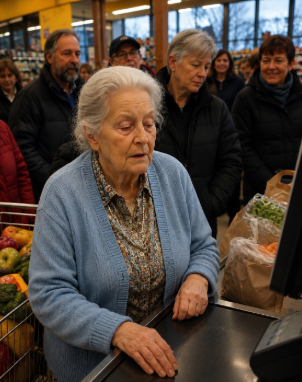
An elderly woman stood at the register ahead of us. Her groceries were already packed into several bags when the cashier quietly asked her to try her card again.
She inserted it.
Waited.
The machine beeped.
Declined.
She tried once more.
The result was the same.
Behind me, someone sighed loudly. Another shopper looked at his phone and shifted impatiently from one foot to the other.
The woman stared at the total on the screen.
Then she reached toward one of her bags.
“I can put something back,” she said.
The first thing she chose was an apple pie.
I don’t know exactly why that bothered me so much.
Perhaps because the pie was clearly not essential. It was probably the one small pleasure among otherwise practical groceries.
Before I could overthink it, I stepped forward.
“Please don’t put anything back.”
She turned toward me.
I handed the cashier my card.
What happened two days later made me understand that a small act of kindness rarely ends exactly where we think it does.
The Woman Ahead of Us
The elderly woman was dressed simply in a gray cardigan beneath a winter coat. She had bread, vegetables, eggs, soup, a small package of chicken and several household items.
Nothing about the cart suggested extravagance.
The apple pie was the only thing that looked like a treat.
When her payment failed, she became visibly embarrassed.
That embarrassment seemed almost more painful than the financial problem itself.
She apologized to the cashier.
Then she apologized to the people waiting.
She should not have needed to apologize to any of us.
Cards are declined for many reasons. Accounts can have insufficient funds, banks can flag transactions, technical problems occur and people occasionally miscalculate what is available.
But checkout lines are public places.
A private financial difficulty can suddenly become a performance in front of strangers.
Everyone can see the total.
Everyone can hear the machine.
Everyone knows something has gone wrong.
“I’ll Pay for It”
I wish I could say I made some thoughtful moral calculation.
I didn’t.
I simply imagined my own mother standing there.
So I spoke.
“I’ll cover it.”
The woman immediately shook her head.
“No, dear. That’s very kind, but I can remove some things.”
“You don’t need to.”
“It isn’t necessary.”
I looked at the cashier.
“Please leave everything.”
The total was not insignificant, but it was an amount I could afford without creating a problem for my family.
That mattered.
Kindness should not require someone to endanger their own ability to pay rent or buy food. Generosity is meaningful precisely because it is voluntary and proportionate to what a person can reasonably give.
The cashier processed my payment.
The woman stood completely still.
Then tears appeared in her eyes.
“You don’t even know me,” she said.
“No,” I answered. “But that’s okay.”
The Apple Pie
She introduced herself as Ruth.
Before leaving, she thanked me several times.
I told her it was unnecessary, but she insisted.
Then she touched the box containing the apple pie.
“This was for my husband’s birthday.”
That changed the meaning of the moment.
I had assumed the pie was simply a treat.
Ruth explained that her husband lived in a care facility nearby. His health had declined, and elaborate celebrations had become difficult. Apple pie had always been his favorite, so she planned to bring one when she visited him.
When her card failed, it was the easiest item to sacrifice.
The groceries were necessary.
The pie was not.
At least not in the financial sense.
But human beings need things that cannot always be classified as necessities.
A familiar dessert.
A birthday candle.
A small tradition.
Something that says: this day still matters.
Ruth thanked me again and walked away.
I expected that to be the end of the story.
The Question My Son Asked
As we pushed our cart toward the parking lot, Noah looked up at me.
“Why did you buy her food?”
“Because she needed some help.”
“Do we know her?”
“No.”
He considered this.
“Then why did you help her?”
Children have a remarkable ability to turn simple moments into complicated questions.
I tried to answer without making myself sound heroic.
“Sometimes you can help someone even if you don’t know them.”
He nodded.
That seemed to satisfy him.
For the rest of the evening, I barely thought about what had happened.
Two days later, we returned to the same supermarket because I had forgotten several things.
That was when Noah suddenly pointed across the store.
“Mom! Look!”
Something Was Happening Near the Entrance
At first, I couldn’t understand what he was pointing toward.
Then I saw Ruth.
She was standing beside a small folding table near the supermarket entrance.
For one irrational second, I wondered whether she had somehow been waiting for us.
She hadn’t.
There was a handwritten sign on the table.
Beside it sat several bags of groceries.
Ruth was talking to a young man holding a toddler.
The man looked embarrassed.
Ruth handed him one of the bags.
Then I understood what was happening.
She was giving food away.
Noah recognized her immediately.
“That’s the lady!”
We walked closer.
When Ruth saw us, her face changed.
She smiled so widely that I almost didn’t recognize the frightened woman from the checkout line.
“You came back,” she said.
“So did you.”
What She Had Decided to Do
Ruth explained that the problem with her card had been temporary. A payment she expected had not cleared when she thought it would, leaving her short at the supermarket.
By the following day, the issue had been resolved.
She had considered trying to find me and repay the grocery money, but she did not know my name.
Then she remembered something I had said.
You don’t need to know someone to help them.
So she made another decision.
Instead of attempting to repay me directly, she bought several basic grocery packages and asked the store manager whether she could distribute them to people who needed a little help.
The manager agreed to let her set up near the entrance for a short period.
The handwritten sign did not ask anyone to prove they were poor.
It did not request explanations.
It simply offered food.
“I Couldn’t Pay You Back”
Ruth took my hands.
“I couldn’t pay you back,” she said, “so I thought I could pay someone else.”
I did not know what to say.
The amount I had spent two days earlier suddenly seemed almost irrelevant.
I had thought I was paying for groceries.
Ruth had interpreted the gesture differently.
To her, someone had protected her dignity during an embarrassing moment.
Now she wanted to create that feeling for another person.
That is one of the most powerful qualities of kindness: it can become transferable.
The recipient does not have to return it to the original giver.
They can move it forward.
The Problem With Making Help Humiliating
There was another reason Ruth’s little table stayed with me.
People experiencing financial difficulty often face an additional burden: they are expected to demonstrate their hardship before receiving assistance.
They may have to explain circumstances they would rather keep private.
Informal generosity can sometimes avoid that dynamic.
Of course, individual acts of kindness cannot replace social programs, community organizations or reliable support systems. Food insecurity and poverty are structural problems far larger than one person’s grocery bill.
But small human interactions still matter.
How help is offered can be almost as important as what is offered.
There is a difference between making someone feel rescued and making them feel respected.
At the checkout, I had tried not to ask Ruth questions.
At her table, she did the same.
People could accept a bag and leave.
No interrogation.
No judgment.
What Children Learn by Watching
Noah was fascinated by the whole situation.
He watched Ruth hand another grocery bag to an older man.
Then he looked at me.
“Did she do that because you helped her?”
“I think partly.”
He was quiet for several seconds.
Then he said, “So now he can help somebody too.”
There it was.
A five-year-old had understood the idea better than I could have explained it.
Children learn values not only from what adults tell them but from what they repeatedly observe.
We can lecture about generosity, patience and respect.
But eventually they watch what we do when someone is slowing down the checkout line.
They notice whether we complain.
They notice whether we stare.
They notice whether we treat another person’s embarrassment as entertainment or as a moment deserving privacy.
That afternoon, I realized Noah had been paying attention to far more than I knew.
Kindness Does Not Always Produce a Perfect Ending
Stories about generosity can become unrealistically sentimental if we are not careful.
Not every good deed returns dramatically.
You can help someone and never see them again.
The person may not thank you.
They may not be able to help anyone else.
Sometimes kindness simply solves one small problem for one person on one difficult day.
That is enough.
Generosity does not need a reward to become worthwhile.
What happened with Ruth was memorable precisely because it was unexpected.
I had no reason to believe my decision would create anything beyond that checkout line.
Neither did she.
The Pie Made It to the Birthday
Before we left, I finally asked Ruth about her husband.
She smiled.
The apple pie had reached him.
They had shared it during her visit.
He had eaten only a small piece, but according to Ruth, he recognized the familiar taste and asked for another bite.
She laughed while telling me.
That was when I realized how close the pie had come to being returned to a supermarket shelf.
To everyone watching the checkout problem, it had been the obvious item to remove.
It was dessert.
Unnecessary.
Optional.
But to Ruth, it represented a tradition she was trying to preserve while so much else in her marriage had changed.
Price tags tell us what objects cost.
They do not tell us what those objects mean.
A Different Kind of Repayment
Before leaving the store, Noah and I bought an extra bag of groceries.
Bread.
Pasta.
Cereal.
Canned food.
Nothing complicated.
We brought it to Ruth’s table.
“This is from him,” I said, pointing toward Noah.
He looked extremely proud.
Ruth bent down and thanked him.
Then Noah asked the question that made both of us laugh.
“Who’s going to get it?”
Ruth looked toward the entrance.
“We don’t know yet.”
That answer was perfect.
The person did not need a name.
Neither had Ruth when I helped her.
Neither had I when Ruth decided to continue what had begun in the checkout line.
What Stayed With Me
I used to think kindness worked like a transaction.
Someone needs something.
Another person provides it.
The moment ends.
But perhaps the best acts of generosity behave more like echoes.
They travel beyond the original interaction.
Not always.
Not predictably.
And rarely in ways we can control.
Two days earlier, Ruth had been standing at a register while impatient strangers waited behind her. She had quietly offered to return an apple pie because her card had been declined.
She left the store with her groceries and her dignity intact.
When we saw her again, she was standing on the other side of the experience.
This time she was the person saying, in effect:
Keep the food.
You don’t owe me an explanation.
You’ll be all right.
I had paid one grocery bill.
Ruth turned that moment into something larger.
And my son, watching from beside me, learned a lesson I hope he remembers long after he forgets the supermarket, the shopping cart and even the woman named Ruth.
When kindness is given without demanding repayment, sometimes the most beautiful response is not to send it back.
It is to send it forward.
Отправить ответ