For most students, choosing an outfit for graduation was supposed to be exciting.
For me, it became something else entirely.
While my classmates searched stores and websites for new dresses, I kept thinking about a cardboard box in the back of my closet. Inside were several shirts that had belonged to my father before he died.
I had not been able to give them away.
Some were faded. One had a tiny stain near the pocket that never completely disappeared. Another was a plaid shirt he wore so often that I could picture him in it without even closing my eyes.
They were not valuable clothes.
But to me, they were priceless.
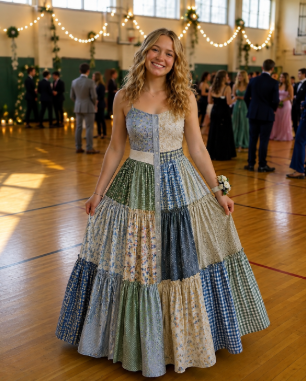
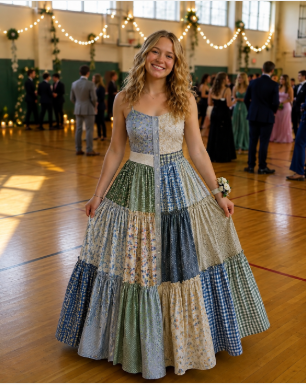
A few months before graduation, I decided to turn those old shirts into my dress.
I knew it would look different from anything anyone else was wearing.
What I did not expect was to walk into the graduation hall, hear people laughing and realize they were laughing at me.
Then the principal approached the microphone.
And suddenly the entire room went silent.
The Box I Could Never Throw Away
My father died when I was fifteen.
There is no convenient age to lose a parent, but fifteen felt particularly cruel. I was old enough to understand exactly what had happened and young enough to still expect him to be present for everything that came afterward.
He would never teach me to drive.
He would not be there when I finished school.
He would never meet the person I might someday marry.
After his death, my mother and I eventually began sorting through his belongings.
It was an ordinary task that felt impossible.
Tools went to relatives. Books were divided between family members. Jackets were donated.
When we reached his shirts, I stopped.
“Can we keep these?”
My mother looked at me and nodded.
We placed them in a box.
For years, that was where they stayed.
An Idea That Sounded Impossible
During my final year of school, graduation became the subject of nearly every conversation.
My friends showed me dresses they were considering.
Some were elegant and simple. Others were expensive enough to make me nervous just looking at the price.
My mother offered to buy me something new.
I appreciated it, but nothing felt right.
Graduation was supposed to represent the end of one chapter and the beginning of another. I wanted to feel that my father was somehow connected to the day.
One evening, I opened the box again.
I spread his shirts across my bed.
Different colors.
Different patterns.
Different memories.
Then I had an idea.
“What if I make my dress out of these?”
My mother stared at me.
“You mean actually cut them?”
“Yes.”
That was the difficult part.
For years I had preserved the shirts because changing them felt almost like losing something.
But objects do not preserve people simply by remaining untouched.
Sometimes memory becomes more meaningful when it is transformed.
My mother understood.
“If you’re sure,” she said, “we’ll figure it out.”
Learning to Build Something From Memory
I was not an experienced dressmaker.
I knew basic sewing, but creating an entire graduation dress from men’s shirts was far beyond anything I had attempted.
So I started slowly.
I watched tutorials.
I made sketches.
I practiced seams on fabric that did not matter.
Eventually, I began taking apart the shirts.
The first cut was terrifying.
I held the scissors against the fabric for almost a minute before closing the blades.
After that, it became easier.
I separated sleeves, collars, backs and pockets. I arranged pieces on the floor and experimented with combinations.
A blue section went beside gray plaid.
A white panel became part of the upper section.
Small pieces from several shirts were joined into the skirt.
I intentionally kept one original pocket.
My father used to place receipts, pens and random scraps of paper in his shirt pockets. Preserving one felt like keeping a recognizable part of him inside the new garment.
The result was not professionally perfect.
That was never the goal.
It was mine.
And it was his.
My Mother’s Reaction
When the dress was finally finished, I tried it on in front of my mother.
She did not speak immediately.
Her eyes moved from one section of fabric to another.
Then she reached toward a piece near my waist.
“I remember this one,” she said.
So did I.
It had come from a shirt my father wore on ordinary weekends.
That was what surprised me most about grief.
The memories that hurt were not always the major events.
Sometimes I missed the completely unimportant moments: him standing in the kitchen, looking for his keys or complaining that somebody had moved the television remote.
The dress contained those ordinary memories.
My mother started crying.
Then I did too.
For the first time, I became completely certain that I wanted to wear it.
Walking Into Graduation
On graduation day, everyone seemed polished.
There were new suits, carefully styled hair, expensive shoes and dresses that looked as though they had been selected months in advance.
Then I walked in wearing a patchwork dress made from old men’s shirts.
People noticed.
Most simply looked curious.
Some friends knew what the dress meant and immediately hugged me.
But a group of students nearby did not know the story.
One pointed toward me.
Another whispered something.
Then they laughed.
I pretended not to hear.
That worked for perhaps thirty seconds.
One of them made a comment about whether I had forgotten to buy a real dress.
Another asked if I had made it from laundry.
I kept walking.
There are moments when you know that responding will only give cruel people exactly what they want.
But knowing that does not make the words painless.
I found my seat and stared toward the stage.
For the first time since making the dress, I wondered whether wearing it had been a mistake.
What People See Before They Know the Story
Judgment often arrives faster than understanding.
The students who laughed saw mismatched fabric and old patterns.
They did not see my father.
They did not see the box that had remained closed for years.
They did not see my mother sitting beside me while I learned to sew pieces together.
They did not know why one pocket had been deliberately preserved.
From their perspective, the dress looked unusual.
From mine, it contained years of memory.
Neither interpretation was visible on the surface.
That difference matters far beyond clothing.
We constantly encounter people without knowing the histories behind their choices.
An old piece of jewelry may look worthless while representing the last gift someone received from a parent.
A damaged book may be kept because of the handwriting inside.
An inexpensive coat may have belonged to someone who is gone.
Objects acquire meaning through stories.
Without the story, outsiders see only the object.
The Principal Walked to the Microphone
The graduation ceremony began.
Students settled into their seats while families filled the room.
After several announcements, our principal stepped onto the stage.
He welcomed everyone and spoke briefly about the graduating class.
Then he paused.
“Before we continue,” he said, “I want to recognize something I learned about this morning.”
I barely paid attention.
Then he said my name.
My stomach dropped.
Every head seemed to turn toward me.
The students who had laughed earlier stopped talking.
The principal explained that one member of the graduating class had arrived wearing something she had created herself.
Then he explained what the fabric had once been.
My father’s shirts.
The room became completely quiet.
He did not describe the dress as fashionable.
He did not call it perfect.
Instead, he spoke about memory.
Graduation, he said, was usually presented as a celebration of individual achievement, but nobody reached such moments entirely alone. Every student carried the influence of people who had taught, supported, encouraged or loved them.
Some of those people were sitting in the audience.
Others could no longer be there.
I lowered my head.
I was already crying.
The Applause I Had Not Expected
The principal asked me to stand.
I did not want to.
For a moment, I seriously considered remaining in my chair.
Then my friend beside me squeezed my hand.
So I stood.
The applause began somewhere behind me.
Then more people joined.
Within seconds, much of the room was clapping.
I looked toward my mother.
She was crying openly.
The dress had not changed.
The same uneven pieces of fabric were still sewn together in exactly the same way.
Yet the room saw it differently because now everyone knew what it represented.
I glanced toward the students who had laughed.
None of them was laughing anymore.
One looked down at the floor.
The Apology After the Ceremony
Later, after certificates had been handed out and families began taking photographs, one of those students approached me.
She looked uncomfortable.
“I’m sorry,” she said.
I did not answer immediately.
She continued.
“I didn’t know.”
That sentence stayed with me.
She was right.
She had not known.
But that was also the problem.
We rarely know the full story of the person standing in front of us.
If kindness is offered only after receiving a satisfactory explanation, it is not much of a principle.
Still, I accepted her apology.
Not because the laughter had suddenly become acceptable, but because people should be allowed to recognize when they have behaved badly and choose differently afterward.
Why Sentimental Objects Matter
Psychologists sometimes describe possessions as extensions of identity and memory.
A familiar object can connect a person to a period of life that no longer exists.
After bereavement, these objects may become especially meaningful.
Keeping them is not necessarily an inability to move forward.
Sometimes they help people carry relationships forward in a new form.
For me, the shirts had originally been preserved exactly as my father left them.
Turning them into a dress changed their purpose.
They were no longer simply evidence of what I had lost.
They became part of something I was still living.
That distinction helped me more than I expected.
He Wasn’t There, but Something of Him Was
Graduation photographs usually capture a particular moment: a young person standing between the familiar world of school and an uncertain adult future.
In my photographs, I am wearing a dress that probably made little sense to anyone who did not know the story.
The patterns do not match perfectly.
Some seams could have been straighter.
No designer would have selected those fabrics to go together.
I would not change any of it.
My father could not sit beside my mother that day.
He could not watch me receive my certificate.
He could not complain about taking too many photographs afterward.
That absence was real, and no dress could erase it.
But grief does not require pretending that the people we lose have disappeared from our lives completely.
Sometimes they remain in habits.
Sometimes in expressions we inherited.
Sometimes in stories.
And sometimes in pieces of fabric carefully sewn together for a day they should have been there to see.
When I first entered the graduation hall, a few people saw an awkward homemade dress and laughed.
By the end of the ceremony, they understood what I had known from the beginning.
I had not worn my father’s old shirts because I could not find something better.
I wore them because there was nothing I could have bought that would have meant more.
Отправить ответ