I did not think I had done anything extraordinary.
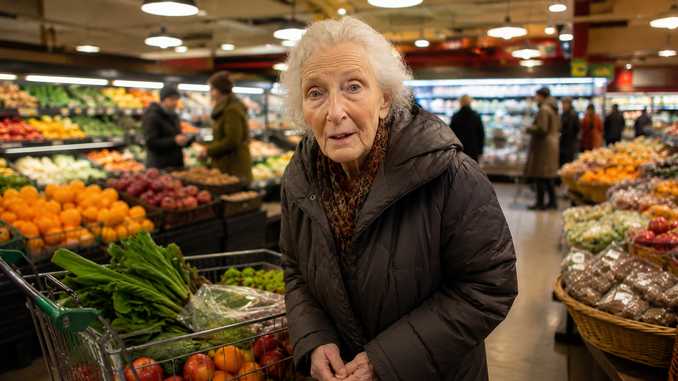
An elderly woman was standing in front of me at the supermarket checkout when her card was declined. She tried it again, then began quietly removing food from her bags.
Milk first.
Then fruit.
Then a package of chicken.
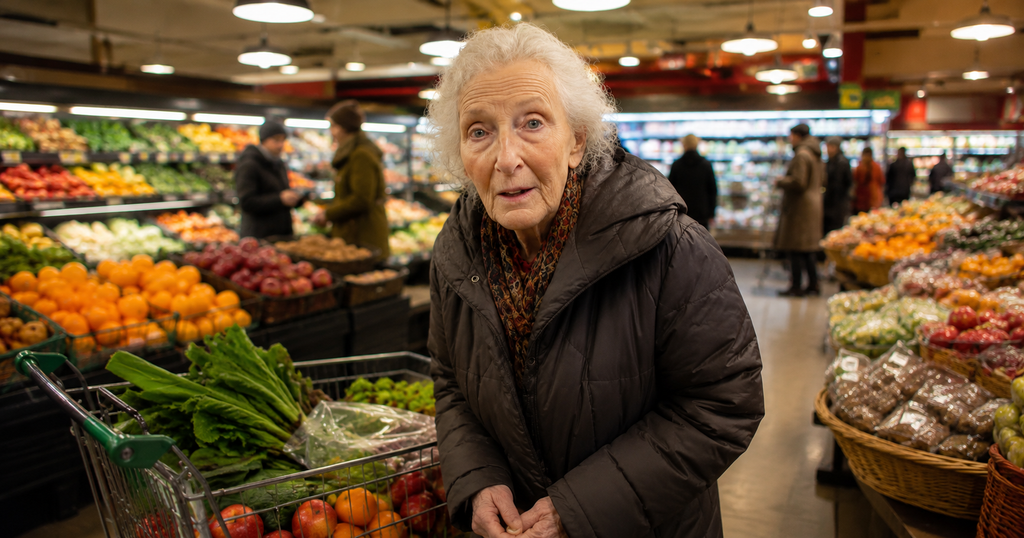
Watching someone decide which groceries she could live without was harder than watching the payment fail.
“How much is it?” I asked the cashier.
The woman immediately shook her head.
“No, please. You don’t have to.”
“I know.”
I paid the remaining amount.
She thanked me several times, and I left with my three-year-old son, Oliver, believing I would never see her again.
Two days later, I heard Oliver screaming from our front yard.
I ran outside expecting blood, a fall or some other emergency.
Instead, I stopped in the doorway.
The elderly woman from the supermarket was standing beside our gate.
And Oliver was pointing at what she had brought with her.
The Woman at the Checkout
The supermarket had been unusually crowded that afternoon.
Oliver was tired and asking repeatedly whether he could open the crackers in our cart.
The woman ahead of us appeared to be in her seventies. Her purchases were ordinary: bread, vegetables, milk, eggs, rice and a few basic household items.
When the cashier announced that her payment had been declined, the woman looked embarrassed rather than surprised.
“Could you try again?”
The cashier did.
Same result.
The woman searched her purse and found a small amount of cash.
It was not enough.
“Take these off,” she said, pointing to several items.
The cashier began removing them.
I watched the total decrease.
The woman seemed determined not to attract attention.
That somehow made the situation more difficult to ignore.
I stepped forward.
“Please put everything back.”
She turned toward me.
“You don’t need to do that.”
“I’d like to.”
After some hesitation, she agreed.
Her name, she told me, was Margaret.
Before leaving, she squeezed my hand.
“I won’t forget this.”
I smiled.
“You really don’t owe me anything.”
At the time, I meant it.
A Small Decision
On the drive home, I barely thought about the incident.
My life was busy.
I was raising Oliver while working from home, and most days seemed to consist of meals, deadlines, laundry and searching for toys that had disappeared five minutes earlier.
That evening, I mentioned the supermarket incident to my husband, James.
“You did the right thing,” he said.
Then we moved on to other things.
There was no reason to imagine the story would continue.
I had not given Margaret my phone number.
I had not told her where we lived.
As far as I knew, she did not even know my surname.
That was why seeing her outside our house two days later was so shocking.
Oliver’s Scream
It happened shortly after lunch.
Oliver had been playing near the front porch while I watched him through the open kitchen door.
Suddenly he screamed.
“Mom! Mom! Come here!”
The fear in his voice made me run.
When I reached the porch, however, Oliver was not frightened.
He was excited.
Standing outside the gate was Margaret.
Beside her was a small red wagon.
Inside it were several potted plants, a basket covered with a cloth and a wooden toy truck.
Oliver was pointing directly at the truck.
“How did you find us?” I asked.
Margaret looked slightly embarrassed.
“The cashier knew your first name, and then I recognized your house.”
That explanation only confused me more.
She reminded me that while leaving the supermarket, Oliver had repeatedly talked about the “blue house with the broken bird mailbox.”
Apparently, our mailbox was more memorable than I realized.
Margaret lived only a few streets away.
She had walked around the neighborhood until she found it.
What She Had Brought
“I told you that you didn’t owe me anything,” I said.
“I know.”
“Then what is all this?”
She uncovered the basket.
Inside was a homemade apple pie.
The plants were herbs and flowers from her garden.
The wooden truck had been made years earlier by her late husband.
“I can’t accept that,” I said immediately.
Margaret shook her head.
“You paid for my food. Let me choose how I say thank you.”
There was no sadness in her voice.
Only determination.
I looked at the truck again.
It was beautifully made, with smooth wooden wheels and faded blue paint.
Oliver was already fascinated.
“Your husband made this?”
“For our grandson.”
I hesitated.
“Then you definitely shouldn’t give it away.”
Her expression changed.
“That’s part of why I came.”
The Story Behind the Groceries
We sat on the porch while Oliver pushed the truck back and forth along the steps.
Margaret explained that her husband, Henry, had died several years earlier.
Their only daughter lived far away, and their relationship had become strained after a family disagreement. Margaret had not seen her grandson in years.
Henry had made the wooden truck when the boy was small.
By the time he finished it, circumstances had already separated the family.
The toy remained unused.
After Henry died, Margaret could never bring herself to throw it away.
“So you kept it all these years?”
“Yes.”
“Why give it to Oliver?”
She watched him play.
“Because toys are supposed to be played with.”
There was something painfully simple about the answer.
The truck had spent years preserving a memory.
Now Margaret wanted it to have a life.
The Declined Card Was a Mistake — But the Problem Was Real
Margaret also explained what had happened at the supermarket.
Her bank had temporarily blocked her card after detecting an unusual transaction. The issue was eventually resolved.
But the embarrassment had revealed something she had been hiding even from herself.
Her finances had become difficult.
After paying for housing, utilities and medication, very little remained each month.
She had enough to survive, but one unexpected expense could create immediate problems.
The failed card had frightened her because, even though the cause was technical, the situation it represented was entirely possible.
“I used to be the person helping others,” she said. “I wasn’t prepared to be the one who needed help.”
That sentence stayed with me.
Accepting kindness can sometimes be harder than offering it.
Why the Visit Mattered
At first, I thought Margaret had come because she wanted to repay the money.
She had not.
The pie, plants and wooden truck were not equal to the grocery bill, nor were they intended to be.
She had come because our brief interaction had reminded her that she was still connected to other people.
Loneliness can make ordinary difficulties feel enormous.
A declined payment becomes more than a banking problem when there is nobody to call afterward.
A quiet house becomes quieter when there is nobody expected for dinner.
Margaret did not need a dramatic rescue.
She needed community.
And without realizing it, I needed some of that too.
Working from home while caring for a small child had gradually narrowed my own world.
I knew neighbors by their cars more often than by their names.
Margaret’s unexpected arrival changed that.
One Pie Became Sunday Lunch
I invited her inside for coffee.
She stayed for nearly two hours.
Oliver showed her every toy he owned, including several that clearly interested her less than the wooden truck.
Before leaving, Margaret gave me instructions for caring for the herbs.
The following Sunday, we invited her for lunch.
She brought another pie.
A week later, she invited us to see her garden.
The relationship developed slowly and without anyone planning it.
Margaret never became a substitute grandmother, and I never tried to become the daughter she missed.
Those roles belonged to other people.
We simply became friends despite the decades between us.
That was enough.
A Difficult Phone Call
Several months later, Margaret told me she had decided to contact her daughter.
She had spent years waiting for the other person to make the first move.
Pride had become a habit.
“I keep thinking about that truck,” she said.
“What about it?”
“Henry made it because he believed there would always be another chance to give it to our grandson.”
She looked toward Oliver.
“Then suddenly there wasn’t.”
She did not want to repeat that mistake.
The first phone call did not repair everything.
Real family estrangement rarely disappears during one emotional conversation.
But it began something.
There were more calls.
Then photographs.
Eventually, Margaret traveled to visit her daughter.
When she returned, she showed me a picture of herself beside a teenage boy I immediately recognized as her grandson.
She was smiling differently than I had ever seen her smile before.
The Truck Stayed With Oliver
I offered to return the wooden truck.
Margaret refused.
“It belongs where Henry would have wanted it,” she said.
By then, the paint had acquired several new scratches.
One wheel squeaked.
Oliver had loaded it with blocks, toy animals, cereal and, on one memorable occasion, mud.
Margaret loved every mark.
The object had stopped being a monument to something lost.
It had become a toy again.
That transformation seemed to matter to her.
Kindness Does Not Need a Perfect Ending
It would be easy to tell this story as though paying for a stranger’s groceries magically solved her life.
It did not.
Margaret still had financial concerns.
Her relationship with her daughter still required work.
Loneliness did not vanish immediately.
And I did not become some heroic figure because I paid one supermarket bill.
I happened to be standing nearby when someone needed a little help.
That is all.
But small actions can create consequences nobody predicts.
Sometimes those consequences are not dramatic.
They are a conversation.
A Sunday lunch.
A phone call someone has postponed for years.
A child playing with a wooden truck that once sat forgotten in a cupboard.
What Oliver Saw
Years from now, Oliver probably will not remember the supermarket.
He may not remember screaming when he saw Margaret outside our gate.
But I hope he remembers something about what followed.
I hope he remembers that people can enter our lives unexpectedly.
I hope he understands that generosity does not always move in one direction.
I paid for Margaret’s groceries because she needed help at that moment.
Two days later, she arrived believing she was repaying me.
In reality, she brought something much larger than a pie, some plants and an old toy.
She brought a reminder that kindness is not a transaction.
You do not give twenty dollars and receive twenty dollars of gratitude.
You simply decide what kind of person you want to be when another human being is standing beside you having a difficult day.
I thought the story ended when Margaret walked away from the supermarket with her groceries.
It had barely begun.
Two days later, my son’s excited scream brought me running to the door.
And standing on the other side of our gate was a woman I had expected never to see again, pulling a red wagon behind her and carrying proof that even the smallest act of kindness can travel farther than we imagine.
Отправить ответ