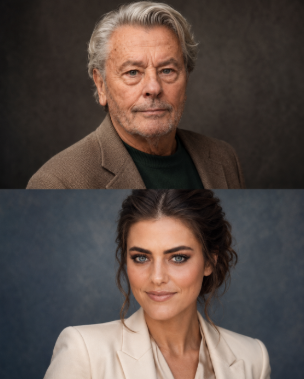
The resemblance is an easy place to begin. Photographs of Alyson Le Borges invite comparisons with the young Alain Delon: the striking eyes, the facial contours, the intensity that seems to hold a camera’s attention. Yet recognizing a family likeness is not the same as understanding a family.
Alyson is the daughter of Anthony Delon and the granddaughter of Alain Delon. Those connections explain the fascination surrounding her image, but they can also obscure the more revealing parts of her story: a childhood spent largely apart from her father, a relationship rebuilt later, and professional ambitions that required more than recognizable features.
Through films including Purple Noon (1960), The Leopard (1963), and Le Samouraï (1967), Alain Delon became one of European cinema’s defining faces. For a granddaughter who resembles him, that legacy creates an introduction before she has said a word.
A famous family, but not a shared childhood
Born on September 4, 1986, Alyson is Anthony Delon’s eldest daughter. Her mother, Marie-Hélène Le Borges, was a dancer at the Crazy Horse in Paris. Alyson grew up with her mother in Neuilly-sur-Seine rather than in the continuous presence of her famous father.
This is the part of her biography that complicates the usual celebrity-family narrative. A celebrated grandfather does not automatically mean a childhood surrounded by film sets, close family gatherings, and constant encouragement from established stars. Biological connection and everyday closeness are different things.
A 2010 Vogue Italia profile reported that Alyson first met Alain Delon when she was eleven. The same profile described a young woman interested in acting and determined to establish herself without relying on the family name. (Vogue Italia)
Her professional name is Alyson Le Borges, her mother’s surname. Remembering that name keeps the maternal side of her history in view; it is not simply an omission of the better-known one.
Recognition came before reconciliation
Anthony Delon’s relationship with his eldest daughter was not straightforward. He discussed her existence in his 2008 autobiography, Le Premier Maillon. Subsequent reporting described paternity testing, legal proceedings, and a period of estrangement.
Public acknowledgment and a functioning parent-child relationship are different milestones. Accounts of the dispute also include Anthony’s perspective; they do not establish Alyson’s feelings or her mother’s intentions.
A more visible change came in August 2015, when Anthony and Alyson appeared together in Paris Match. Contemporary coverage presented their joint appearance as the beginning of a renewed relationship after years of distance. The important development was not simply that a family connection had become public, but that father and daughter were attempting to create a relationship in adulthood.
Alyson later offered her own perspective. In comments to ¡HOLA! in 2021, subsequently quoted by La Nación, she acknowledged that lost time and the absence of paternal support during her upbringing could not simply be recovered, while saying that their relationship was then in a better place.
That is a more human conclusion than a perfect reunion. Improvement does not require pretending the earlier years were different. Nor does a public photograph establish that every private difficulty has disappeared. Her words allowed room for both an absence that mattered and a relationship that had changed.
Training, restaurant shifts, and work in front of the camera
The family story is compelling, but it should not consume the professional one.
Long before later profiles revisited the Delon connection, Vogue Italia documented Alyson’s acting studies at the Cours Simon in Paris. It also reported that she worked as a waitress in an Italian restaurant in Neuilly to help pay for her training.
The magazine described her work for Vanity Fair Italia in 2009, appearances in publications including Grazia France, and modeling for Intimissimi. It presented acting as an ambition she continued to pursue alongside fashion work.
These are modest, concrete details compared with the grand language often used about celebrity descendants. That is precisely why they matter. Classes, paid shifts, auditions, and assignments describe actual work. They offer a fuller picture than a claim that someone was destined for success because of a famous face.
Modeling and acting also ask different things of a performer. A photograph can make resemblance the central attraction. A dramatic role demands the creation of a character through voice, timing, movement, and interaction with others. A family likeness may draw attention, but it cannot perform those tasks on its own.
A father’s praise—and the limits of a prediction
In a March 2024 appearance on the French television program Quelle époque!, Anthony spoke about Alyson’s acting potential. He described helping arrange an introduction to an agent and rehearsing an audition text with her. According to his account, the agent agreed to represent her after the test.
Anthony praised her instincts and suggested she might continue the family’s acting tradition. He also stressed the need for work and commitment. These were a father’s assessments of her abilities, not independent proof of an inevitable career breakthrough.
The episode adds an important complication. It would be inaccurate to tell her story as though family connections had never played any part. It would be equally misleading to suggest that an introduction makes preparation unnecessary or explains every professional outcome.
The more credible account allows both realities to exist. Family access can create an opportunity; what happens next still involves individual work, circumstances, and decisions.
Likewise, a parent’s hope that a child will continue a tradition does not create an obligation for that child to do so. Alyson’s life need not become a sequel to anyone else’s.
More than the continuation of a legend
Alain Delon died on August 18, 2024, at the age of eighty-eight. His film legacy remains an important part of the context in which his descendants are discussed.
But there is a difference between remembering an actor through his films and expecting his family to reproduce him. A resemblance can be admired without being turned into a forecast about talent, temperament, or destiny.
Alyson’s story is most interesting when those expectations loosen. It contains a maternal upbringing, difficult questions of paternal recognition, later reconciliation, and work across fashion and acting. None of those experiences can be read reliably from a portrait.
The unexpected part is not a sensational secret hidden behind beautiful features. It is the gap between what a famous bloodline seems to promise and what a person actually lives.
Alyson Le Borges may remind viewers of Alain Delon. Understanding her means looking beyond that first impression—and allowing the woman in the photograph to have a biography of her own.
Отправить ответ