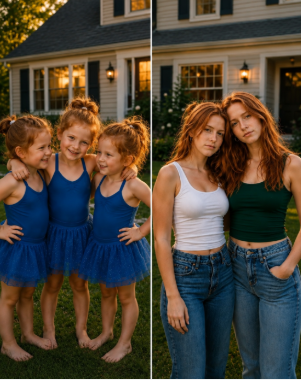
Some birthdays are filled with balloons, laughter and photographs that capture nothing but joy.
Ours was different.
For ten years, our mother had kept a small wooden box hidden in the highest shelf of her bedroom closet. We knew it existed because we had seen her take it down every year on our birthday, hold it for a few silent moments, and place it back without opening it.
She never explained why.
On the morning of our twenty-first birthday, she finally carried the box into the dining room and placed it beside the cake.
Resting on top was an envelope addressed in handwriting we had not seen since we were children.
“Open on our 21st birthday.”
It was signed with the name of our triplet sister, Lily.
She had died when we were only eleven years old.
None of us was prepared for what waited inside.
Three Girls Who Were Never Really Alike
People always imagined that triplets must be nearly identical.
The truth was much more interesting.
Emma loved books and could disappear into a novel for hours. I, Sophie, was endlessly curious and constantly taking apart radios, clocks and anything else I thought I could rebuild. Lily, meanwhile, seemed to collect people instead of hobbies. She remembered everyone’s birthday, noticed when classmates were lonely and somehow convinced strangers to smile within minutes of meeting them.
Our teachers used to joke that together we made one complete person.
Growing up, we shared everything: a bedroom, birthday cakes, school uniforms and the strange experience of answering to the wrong name almost every day.
We also shared a secret language of glances that our parents never fully understood.
If one of us was nervous, the other two knew before she said a word.
It felt impossible to imagine that bond ever breaking.
Then everything changed in a single autumn.
The Year We Lost Lily
Lily became ill shortly after our eleventh birthday.
At first, everyone assumed it was an ordinary virus. But the weeks passed, and the hospital visits became more frequent. Our parents stopped pretending that everything was fine.
Children notice fear even when adults try to hide it.
The hospital became our second home. We brought Lily homework, drew pictures together and argued about whose turn it was to choose the movie playing on the small television in her room.
She never complained.
Even on difficult days, she somehow ended up comforting us.
One afternoon she asked our mother for paper, colored pencils and a small wooden craft box.
We thought she wanted another art project.
None of us knew she was preparing something that would outlive her.
A few weeks later, Lily was gone.
Our family never became the same again.
The Birthday Tradition
After Lily died, birthdays became complicated.
Friends wanted to celebrate. Relatives tried to make us smile. But every birthday also reminded us that someone was missing from the photograph.
Our mother created a quiet tradition.
Every year she baked the same chocolate cake Lily had loved most. Three candles were always placed on top—not because three daughters were present, but because she refused to pretend there had ever been only two.
After everyone went home, she disappeared into her bedroom for a few minutes.
Emma once asked what she was doing.
Mom simply answered, “Keeping a promise.”
She would say nothing more.
For ten years, we respected her silence.
Twenty-One
The morning of our twenty-first birthday felt strangely peaceful.
Emma had returned from university the night before. I had taken the day off from work. Mom insisted on making breakfast herself, though she barely touched her own food.
Then she stood, walked upstairs and returned carrying the wooden box.
It was smaller than I expected.
The wood had darkened with age, and the corners were worn smooth from years of careful handling.
She placed it beside the cake.
“I’ve waited a long time for this,” she whispered.
None of us moved.
Finally, Mom handed the envelope to Emma.
“It belongs to both of you.”
Emma opened it with trembling hands.
Inside was a folded letter.
Lily’s Letter
The first line made all three of us cry.
“If you’re reading this, then you both survived becoming adults. I knew you would.”
The letter wasn’t sad.
That surprised us most.
Lily wrote as though she had simply stepped into another room and expected to rejoin the conversation later.
She remembered the games we invented in our bedroom, the treehouse we believed was a castle and the argument about which of us would someday own a bakery.
Then the letter became more personal.
She wrote separately to each of us.
To Emma:
“Don’t hide inside books forever. They’re wonderful, but people need your kindness too.”
To me:
“You always wanted to fix broken things. Just remember that people can’t always be repaired with answers.”
Then she addressed our mother.
“Mom, if you’ve actually waited until they’re twenty-one, thank you for keeping your promise.”
Our mother quietly nodded through her tears.
She had never broken it.
Inside the Wooden Box
We expected jewelry.
Perhaps photographs.
Instead, the box contained dozens of tiny objects, each carefully wrapped and labeled.
There was a friendship bracelet Emma had made when we were eight.
A marble I had cried over after losing it during recess.
A pressed daisy from our favorite meadow.
Three tiny seashells collected during our last family vacation.
Each object came with a handwritten note explaining why Lily had saved it.
“These aren’t valuable,” one note read. “They’re proof that ordinary days become precious later.”
Near the bottom lay something wrapped in blue fabric.
Inside was a silver locket.
When opened, it revealed the tiniest photographs of the three of us laughing on a playground.
None of us remembered that picture being taken.
Mom smiled through her tears.
“Your grandfather carried a camera everywhere.”
The Last Envelope
Beneath everything else rested one final sealed envelope.
Across the front Lily had written:
“For your future.”
Inside was another letter.
This one was different.
Rather than remembering the past, Lily imagined the lives she hoped we would have.
She hoped Emma would become a teacher because she loved explaining stories better than anyone.
She hoped I would keep inventing things, even if they occasionally exploded—as several childhood experiments certainly had.
She hoped we would forgive ourselves for growing older without her.
That sentence stopped us completely.
“Please don’t feel guilty every birthday. Someone has to grow up for me too.”
For years, neither Emma nor I had admitted the strange guilt we carried.
Every achievement felt slightly unfair.
Graduation.
Driving.
Falling in love.
Turning eighteen.
Reaching twenty-one.
Lily had somehow anticipated a feeling she would never live long enough to experience herself.
Why Mom Never Opened It
Later that evening, I finally asked the question I had wondered about for a decade.
“Didn’t you ever want to look inside?”
Mom laughed softly.
“Every single year.”
“Then why didn’t you?”
She looked at the box before answering.
“Because it wasn’t mine.”
Lily had trusted her with a responsibility, not a gift.
There were nights, Mom admitted, when grief almost convinced her to break the seal just to feel closer to her daughter.
She never did.
Keeping the promise became its own conversation with Lily.
Each birthday, she chose patience over curiosity.
That may have been the hardest act of love she ever performed.
The Gift Was Never the Objects
In the weeks that followed, Emma and I divided nothing.
The bracelet stayed in the box.
So did the marble, the flower and the seashells.
The locket belonged to all three sisters, including the one who was no longer physically with us.
We realized the real inheritance had never been the objects themselves.
It was perspective.
Lily had spent her final weeks collecting evidence that small moments matter.
Not birthdays with expensive presents.
Not perfect holidays.
The things she chose were astonishingly ordinary: a flower, a shell, a bracelet made from cheap thread.
She had understood at eleven what many adults spend a lifetime learning—that memories attach themselves to meaning, not price.
Learning to Celebrate Again
That year, for the first time since childhood, we ended our birthday by laughing.
Not because grief disappeared.
It never does.
It simply changed shape.
Instead of feeling that birthdays measured Lily’s absence, we began feeling that they also measured her presence in unexpected ways.
We still placed three candles on the cake.
We still kept the wooden box.
But now we opened it every birthday—not to discover something new, but to reread the letters that reminded us who we had been together.
People often think the greatest gifts are the ones hidden in vaults, locked rooms or secret compartments.
Our greatest inheritance fit inside a weathered wooden box.
It contained no fortune.
Only a little girl’s handwriting, a handful of ordinary treasures and enough love to survive ten silent years.
Sometimes that is worth more than anything money could ever buy.
Отправить ответ