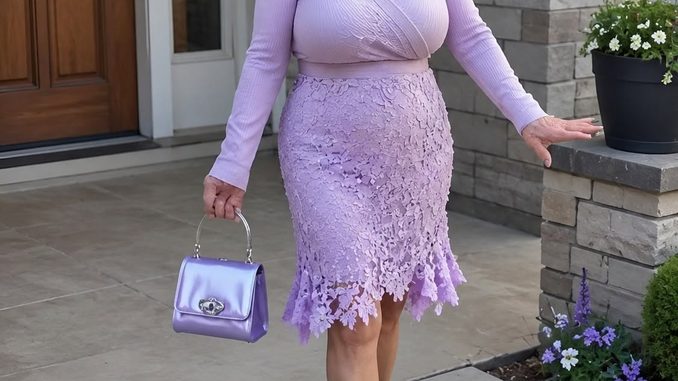
At an age when many people are told to become quieter, more cautious and less visible, one 92-year-old woman has chosen the exact opposite path.
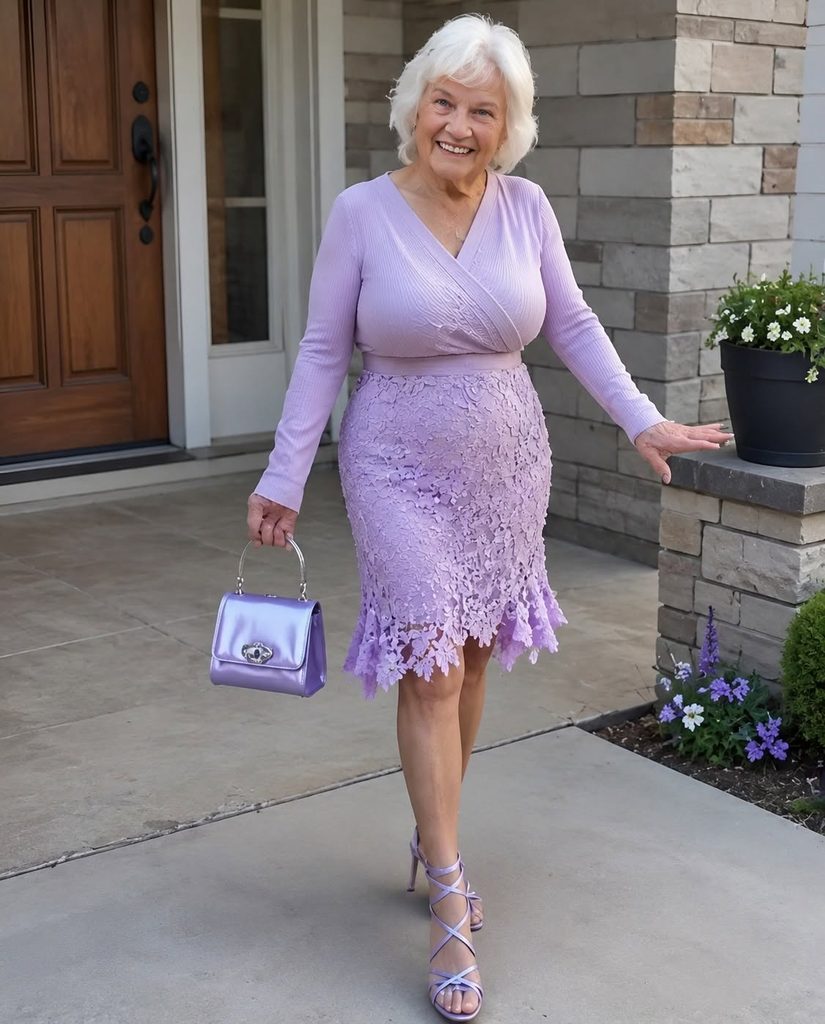
She wears miniskirts.
She walks in high heels.
She experiments with bold outfits and carries herself with the confidence of someone who has never accepted the idea that growing older means giving up the things that make you feel alive.
And perhaps the most remarkable part is not what she wears.
It is the fact that she refuses to ask anyone for permission.
For decades, women have been surrounded by invisible rules about how they are supposed to look at different stages of life. Certain clothes are considered suitable for young women. Others are supposedly reserved for older women. At some point, society quietly expects a woman to stop drawing attention to herself and begin dressing according to what other people consider “appropriate.”
But she never agreed to those rules.
At 92, she has decided that her birth year does not get to determine the length of her skirt, the height of her heels or the colors she chooses to wear.
For her, clothing has never been simply about following fashion.
It is about personality.
It is about freedom.
And above all, it is about feeling like herself.
That attitude becomes especially striking when she steps outside dressed in a way that some people would expect from someone decades younger. A short skirt, elegant heels and a carefully chosen outfit might immediately attract attention.
Some people smile.
Some stare.
Others cannot resist offering an opinion.
But she continues walking.
She does not rush to explain herself.
She does not lower her head.
And she certainly does not change her clothes simply because somebody else has decided that a particular style belongs to a particular age group.
There is something powerful about that kind of confidence.
It does not come from trying to look younger.
That distinction matters.
She is not pretending to be twenty, thirty or forty. She is a 92-year-old woman who happens to enjoy fashion. Her goal is not to erase the years behind her but to live comfortably inside the person she has become.
That is why her appearance can be so surprising.
People often associate aging with restriction. They imagine that getting older naturally means giving up certain pleasures, becoming more conservative and gradually disappearing from the visual world around them.
Yet there is no universal rule saying that confidence must disappear with age.
There is no expiration date on elegance.
And there is certainly no age at which a person suddenly stops having the right to enjoy beautiful clothes.
Her approach challenges an assumption many people rarely question: that fashion belongs primarily to the young.
Look at a magazine, an advertisement or a clothing campaign, and youth is often presented as the natural center of style. Older people are frequently shown in practical clothing, neutral colors and carefully restrained silhouettes.
There is nothing wrong with dressing that way, of course.
The problem begins when personal choice is replaced by expectation.
An older woman who enjoys simple clothes should be free to wear them.
An older woman who loves colorful dresses should be free to choose those instead.
And a 92-year-old who feels wonderful in a miniskirt and high heels should not have to defend herself simply because other people are uncomfortable with the sight.
Her philosophy is refreshingly simple: wear what makes you happy.
That does not mean every outfit is about attracting attention.
Quite the opposite.
The confidence behind her style seems to come from knowing that she does not need universal approval.
That is something many younger people struggle to learn.
At twenty, a person may spend an entire afternoon wondering what friends will think of a particular outfit. At thirty, they may worry about colleagues. At fifty, they may wonder whether a certain style is still “for them.”
And then there are people who eventually reach a point where those questions become much less important.
They simply know themselves.
Perhaps that is one of the hidden gifts of growing older.
You begin to understand that other people’s opinions are temporary.
Your own sense of self is what remains.
For this woman, fashion has become a small but visible expression of that lesson.
Every time she puts on a pair of high heels, she is making a choice.
Every time she wears a short skirt without embarrassment, she is rejecting the idea that aging should automatically make a person ashamed of being seen.
And every time she walks confidently into public, she reminds people that age is a number, not a complete description of a human being.
Of course, confidence does not mean that criticism disappears.
It never does.
Someone will always think an outfit is too bold. Someone else will believe it is inappropriate. Another person may simply be surprised because they have never seen someone in their nineties express themselves so freely.
But criticism becomes less powerful when the person receiving it no longer depends on approval.
That may be the most inspiring part of her story.
She is not trying to convince everyone to dress like her.
She is not suggesting that every 92-year-old should wear miniskirts or high heels.
Her message is much broader.
Choose for yourself.
If you prefer a long dress, wear it.
If you love trousers, wear them.
If bright colors make you happy, stop worrying about whether they are “too much.”
And if you happen to feel beautiful in an outfit that someone else considers too young for you, remember that the person who has to live in your body every day is you.
There is also something deeply human about the joy she seems to find in getting dressed.
Fashion is often dismissed as superficial, especially when it involves older people. Yet clothing can carry memories, identity and emotion. A particular color can remind someone of an important period in life. A favorite pair of shoes can become associated with unforgettable moments. A carefully chosen outfit can change the way a person carries themselves.
Sometimes, getting dressed is not about impressing anybody.
Sometimes it is simply a way of saying, “I am still here.”
That message becomes particularly meaningful at 92.
She has lived through decades of changes in society, fashion and culture. Trends that were once considered daring eventually became ordinary. Styles disappeared and returned. Entire generations grew up, changed and moved on.
And through all of it, the basic human desire remained the same: to feel comfortable being yourself.
Her story also raises an uncomfortable question for everyone watching.
Why are people so quick to judge what an older woman wears?
Would the same outfit provoke the same reaction if she were twenty-five?
And why should someone’s age determine whether they are allowed to feel attractive, playful, elegant or fashionable?
These questions go far beyond one woman’s wardrobe.
They touch on the way society views aging itself.
Too often, getting older is presented almost entirely as a process of losing things: youth, beauty, energy, possibilities.
But aging can also bring something that cannot be bought.
Perspective.
Experience.
Self-knowledge.
And, for some people, the courage to stop living according to rules that never made sense to them in the first place.
Perhaps that is why her appearance has such an effect on those who see her.
The heels are noticeable.
The miniskirts are noticeable.
The confidence is impossible to miss.
But underneath all of that is a much quieter message.
You do not suddenly become invisible because you have reached a certain birthday.
You do not lose your personality because your hair has turned gray.
You do not have to abandon everything you enjoy simply because someone else believes your age requires a different version of you.
At 92, she continues to dress according to her own taste.
Not because she is trying to prove something.
Not because she wants to compete with younger women.
And not because she refuses to acknowledge her age.
She simply refuses to let a number decide who she is allowed to be.
Perhaps that is what makes her style so memorable.
The real statement is not the short skirt.
It is not the high heels.
It is not even the attention she receives when she walks into a room.
The real statement is the confidence with which she keeps moving forward.
Because style, in the end, has very little to do with age.
It has much more to do with knowing who you are — and having the courage to remain that person, even when the world insists that you should change.
Отправить ответ