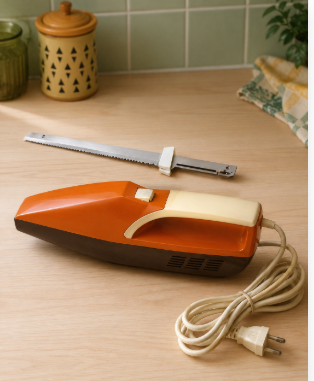
There was a time when an unfamiliar household object could tell you exactly what decade someone had grown up in.
Today, many people would probably have no idea what to do with this strange little device. Its shape might suggest a small iron, an unusually designed vacuum cleaner, or even a miniature kitchen appliance. It looks simple, slightly awkward and almost comical by modern standards.
Yet decades ago, an object like this could be closely connected with one of the most important forms of entertainment in the home: television.
For people who remember the era of black-and-white screens, however, the mystery may disappear almost immediately.
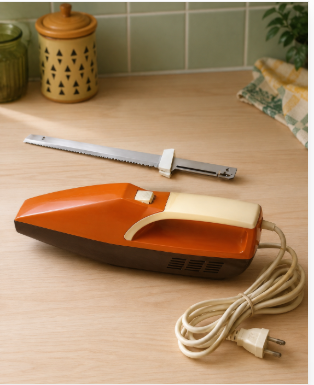
The device belonged to a completely different television experience, from a time when watching a program was not always as effortless as pressing a button on a remote control.
To understand why such an unusual appliance existed, it helps to remember just how different television technology once was.
Modern viewers are accustomed to bright, sharp images, dozens of channels and screens that can be turned on instantly. A television can now be smaller than a piece of furniture and still provide an enormous amount of information.
Earlier generations had none of that convenience.
Television sets were larger, heavier and much more limited. Reception could be inconsistent, images could become distorted, and viewers often had to make adjustments that would seem almost unimaginable today.
The television itself was frequently treated as a valuable piece of equipment.
Families gathered around it.
Children learned the rules of television etiquette from their parents.
Adults adjusted the controls when the picture became unclear.
And when something went wrong, there was not necessarily a simple menu telling you what the problem was.
Sometimes the solution involved a rather strange-looking tool.
That is where the mysterious device comes in.
Its appearance can be misleading because its function was connected not with cooking or cleaning, but with the technology hidden inside older television sets.
To modern eyes, the object seems almost absurdly specialized.
But household technology often reflects the problems people faced at the time.
When a device is familiar, its accessories make sense. Once the technology disappears, those accessories can look completely mysterious.
Think about an old typewriter ribbon, a film projector accessory or a cassette-repair tool. Without knowing what the original machine did, the smaller object can seem completely pointless.
The same principle applies here.
Older television sets relied on components and adjustment systems that are no longer part of everyday life. Getting the best possible picture could require more than simply changing a channel.
The image might shift.
The screen could show interference.
The picture might need to be adjusted carefully.
And certain technical components required specialized handling.
For television owners who grew up during that period, these problems were simply part of normal life.
There was no expectation that technology would always work perfectly at the touch of a finger.
People were often much more involved with the machines they owned.
They learned which knobs affected the picture.
They knew when the television needed attention.
Some could even recognize a problem simply by the way the screen looked or sounded.
That familiarity is difficult to imagine today.
A child growing up with streaming services may never have experienced the ritual of waiting for a television to warm up. They may never have watched an image gradually appear on an old screen or heard the characteristic sounds produced by vintage equipment.
For earlier generations, however, these details were ordinary.
Television was still relatively magical, but it was also mechanical.
The strange appliance was part of that world.
Its design may look primitive now, but it represented a practical response to the technology of its time.
This is one reason old household objects are so fascinating.
They preserve problems that modern technology has completely eliminated.
A device that once solved an everyday inconvenience can become incomprehensible when the inconvenience itself disappears.
Imagine explaining to someone who has always used a modern television that there was once a time when maintaining a clear picture could require physical adjustment of the equipment.
The explanation might sound almost unbelievable.
Yet millions of households became accustomed to it.
Television ownership itself was once something special.
A family did not necessarily have several screens throughout the house. One television could become the center of the home.
People planned evenings around programs.
Neighbors sometimes visited each other to watch important broadcasts.
Children gathered together when their favorite shows came on.
Major events could bring entire families into the same room.
The television was not simply another appliance.
It was a shared experience.
That makes the forgotten tools associated with it even more interesting.
They belonged to a period when technology encouraged people to interact with machines differently.
Instead of expecting perfection, people learned to work around limitations.
Instead of replacing something immediately, they tried to repair it.
Instead of throwing away an appliance because it behaved strangely, they often looked for the cause.
There was a certain patience involved.
And there was knowledge.
Someone in the family usually knew how to adjust something, replace a part or make a stubborn machine work again.
Of course, that does not mean older technology was necessarily better.
It was often less convenient, less reliable and much more demanding than what people use today.
But it created a different relationship between people and their possessions.
Many older adults still remember the satisfaction of fixing something themselves.
They remember the tools that lived in drawers, cabinets or garages.
They remember appliances that had physical switches, mechanical parts and components that could actually be examined.
The mysterious television accessory belongs to that same disappearing world.
Its importance was never about its appearance.
It was about what it allowed people to do.
And once you understand the technology behind it, the strange shape suddenly becomes less strange.
This is why vintage objects can trigger such powerful memories.
Someone who sees the device for the first time today may see nothing more than an odd piece of plastic and metal.
Someone who used one decades ago may immediately remember an entire room.
Perhaps there was a large television standing against the wall.
Maybe there was a crocheted cover protecting it from dust.
Perhaps the family sat nearby while the evening program played.
The object itself may have been small, but the memories surrounding it can be enormous.
There is also an important lesson hidden in these forgotten appliances.
Technology changes so quickly that today’s ordinary objects can eventually become historical curiosities.
Consider how rapidly household entertainment has evolved.
Television moved from black-and-white to color.
Controls became more sophisticated.
Remote controls replaced manual adjustments.
Cathode-ray screens gave way to flat displays.
Broadcast television was joined by cable and satellite services.
Later came digital television, internet-connected screens and on-demand viewing.
Each stage eliminated some of the inconveniences of the previous one.
With every improvement, another collection of tools became unnecessary.
Eventually, the tools themselves disappeared from ordinary homes.
That is how technological history often works.
The main machine survives in photographs and museums, while the small accessories that made it functional are forgotten.
People remember the television.
They remember the programs.
They remember famous broadcasts.
But they may not remember the humble devices that helped keep those televisions working.
And that is precisely why an apparently useless object can be so revealing.
It tells us not only what technology looked like, but also how people lived with it.
There was more physical interaction.
There was more waiting.
There was often more maintenance.
And there was a stronger sense that a machine was something you could understand rather than merely consume.
For younger generations, this may seem like an entirely different world.
Yet older technology has a way of making history feel surprisingly personal.
A photograph of an old television may seem distant.
A strange tool sitting beside it can suddenly make the past tangible.
You can imagine someone reaching for it when the picture became unstable.
You can imagine a parent showing a child what to do.
You can imagine the quiet concentration required to make a machine behave properly.
Those moments were ordinary at the time.
Nobody thought they were historical.
That is perhaps the most interesting part.
History is not always created by spectacular events.
Sometimes it is preserved in the objects people used every day without giving them a second thought.
A television accessory, an old kitchen tool, a mechanical calculator or a piece of early recording equipment can tell us something that a history book cannot.
It can show us what everyday life actually felt like.
And this mysterious little machine is a perfect example.
To someone unfamiliar with older television technology, its shape may invite all sorts of guesses.
An iron?
A miniature vacuum?
A strange kitchen gadget?
But for those who remember the era of black-and-white television, the answer may bring back something much more valuable than the name of the device.
It may bring back the sound of an old television coming to life.
The glow of a screen in a darkened room.
The family sitting together.
And a time when watching television was not simply a matter of pressing a button and forgetting about the technology behind the picture.
Today, we expect our devices to disappear into the background.
We want instant results.
We want perfect images.
We want everything to work automatically.
Older generations had a different relationship with technology.
They had to understand it, adjust it and sometimes patiently persuade it to cooperate.
That forgotten little appliance is a reminder of that era.
And perhaps that is why objects like this continue to fascinate people long after the technology they were designed for has vanished.
They are not merely old machines.
They are pieces of everyday history — small reminders of a world that once seemed completely ordinary, but now feels almost impossible to imagine.
Отправить ответ