My mother was not looking for a secret.
That is probably the strangest part of what happened. There was no suspicion, no argument, no dramatic discovery preceded by weeks of unanswered questions. She simply needed an old document and believed my father had put it somewhere in his desk.
By the end of that afternoon, however, we were sitting at the kitchen table with an object between us that neither of us recognized.
And for the first time in my life, I began to wonder how much I really knew about my father.
The drawer he rarely opened
My parents had lived in the same house for almost thirty years. It was an ordinary two-story home in a quiet neighborhood, the kind of place where nothing seemed capable of remaining secret for very long.
My father, Daniel, had always been extremely organized. Bills went into labeled folders. Tools returned to the same hooks after every repair. Important documents were kept in a wooden desk in the small room he called his office.
There was one drawer, however, that he almost never used in front of us.
We had never considered that unusual.
One Saturday afternoon, while my father was away visiting an old friend, my mother needed paperwork connected to an insurance policy. She called him, and he told her the documents should be somewhere in his desk.
After checking two drawers without success, she opened the bottom one.
Inside were old receipts, photographs, envelopes and several notebooks.
Then she noticed a small package underneath everything else.
It was wrapped in a faded piece of cloth.
Curiosity won.
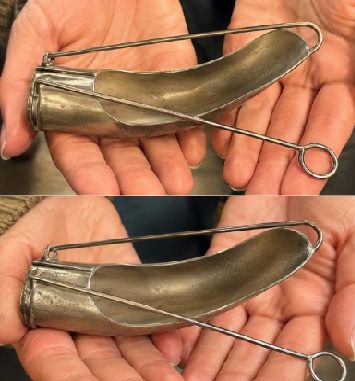
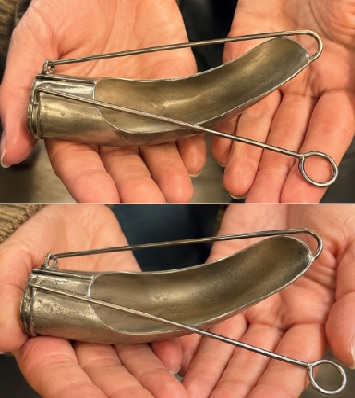
My mother unfolded the material and discovered a narrow metal object roughly the length of her hand. It was heavier than it looked and covered with scratches. One end contained a small circular opening, while the other had a movable section that seemed to slide backward.
There were no obvious labels.
Only three letters and a number had been engraved into the metal.
She called me into the room.
“Have you ever seen this before?”
I hadn’t.
At first we assumed it was some forgotten tool. My father had always enjoyed repairing old machines, so finding an unfamiliar mechanical object among his possessions was hardly shocking.
But something about the way it had been hidden bothered my mother.
If it was merely a tool, why wrap it carefully and bury it beneath decades of paperwork?
A photograph changed everything
We continued looking through the drawer, partly because my mother still needed the insurance document and partly because our curiosity had become impossible to ignore.
Under a stack of envelopes, I found an old photograph.
My father was standing beside another young man.
He could not have been older than twenty-five.
Behind them stood an industrial building with large windows and a metal gate. The photograph had faded badly, but my father was unmistakable.
What caught my attention was the object in the other man’s hand.
It looked almost identical to the thing we had just found.
I turned the photograph over.
Two names had been written on the back.
“Daniel and Thomas.”
Below them was a date from more than three decades earlier.
Neither my mother nor I knew anyone named Thomas.
That was when the discovery stopped feeling amusing.
My parents had been married for twenty-eight years. My mother knew most of my father’s old friends. She knew where he had studied, where he had worked and even the names of several people he had known as a teenager.
But she had never heard him mention Thomas.
We decided not to search through anything else.
Instead, we placed the object and photograph on the kitchen table and waited.
My father’s reaction
He returned shortly after six.
He walked into the kitchen carrying groceries, smiled at us and immediately noticed what was lying on the table.
The smile disappeared.
For several seconds, he said nothing.
My mother asked the obvious question.
“What is this?”
My father put the grocery bag down.
“Where did you find it?”
“In your desk.”
He closed his eyes briefly.
I expected anger. Instead, he looked exhausted.
Then he pulled out a chair and sat down.
“That should have been thrown away years ago,” he said.
My mother pushed the photograph toward him.
“And Thomas?”
That changed his expression again.
He stared at the photograph for a long time before answering.
“He was my best friend.”
It was the first time either of us had heard the name.
A life before our family
Long before he met my mother, my father had worked for a small manufacturing company that produced components for industrial machinery.
Thomas worked there too.
They had met during their first week and quickly became close friends. They were young, ambitious and convinced that the factory job was temporary. They talked about starting a repair business together.
The strange metal object was connected to their work.
It was not valuable, dangerous or mysterious by itself. It was part of a measuring mechanism used during maintenance on one of the factory’s older machines.
But the object had become important because of what happened one night.
My father explained that the factory occasionally operated late when large orders had to be completed. During one such shift, a machine began behaving irregularly.
Thomas noticed the problem first.
According to my father, the machine should have been shut down immediately and inspected.
But production was already behind schedule.
Work continued.
Later that night, something failed.
My father did not describe the accident in graphic detail. He simply told us there had been a serious mechanical failure and Thomas had been badly injured.
He died later.
The room became completely silent.
Suddenly the little piece of scratched metal on the table no longer looked harmless.
Why he kept it
My mother asked the question that had been troubling both of us.
“Why would you keep something connected to that?”
My father looked at the object.
Because, he explained, he had spent years blaming himself.
He and Thomas had inspected the machine earlier that evening. They had both noticed signs that something was wrong. Thomas wanted to report the problem again.
My father had hesitated.
He was afraid they would be blamed for delaying production.
He convinced himself that the machine could finish the shift.
That decision haunted him.
Whether shutting the machine down would definitely have prevented the accident was something my father could never know. Mechanical failures can involve multiple causes, and memories formed during traumatic events are not always reliable evidence of exactly what would have happened under different circumstances.
But emotionally, none of that mattered to him.
He believed he had failed his friend.
The metal component had been removed during the investigation that followed. Much later, when damaged equipment was being discarded, my father kept the piece.
It became a reminder.
Not of the accident itself, he insisted, but of the moment before it.
The moment when he had known something was wrong and had remained silent.
The rule we never understood
As he spoke, several things from my childhood suddenly made sense.
My father had always been unusually strict about safety.
If a tire looked worn, he replaced it.
If an electrical socket became loose, nobody was allowed to use it until he repaired it.
If someone at work told him a machine was “probably fine,” that phrase irritated him more than almost anything else.
Once, when I was seventeen, I drove home with a strange noise coming from the front of my car. I remember him becoming furious when I admitted that I had noticed the sound several days earlier.
“Machines warn you,” he told me. “Your job is to listen.”
At the time, I thought he was simply being dramatic.
Now I understood where those words came from.
He had built an entire philosophy around one terrible experience.
If something seemed unsafe, he stopped.
If someone raised a concern, he listened.
He never again wanted convenience, embarrassment or pressure to silence that instinct.
The second secret
There was still something my mother wanted to understand.
Why had he never told her?
My father’s answer was quieter than the rest of the story.
He was ashamed.
Not because anyone had officially blamed him for Thomas’s death. According to my father, the accident involved failures far beyond the actions of two young workers.
But guilt does not always follow official conclusions.
He had replayed that evening for years.
What if he had insisted?
What if he had refused to continue working?
What if he had supported Thomas instead of telling him they could finish?
Eventually my father changed jobs and moved away. He met my mother several years later.
He tried to leave the accident behind.
But he kept the metal piece.
That contradiction was difficult even for him to explain.
He wanted to forget, yet he was afraid of forgetting the lesson.
So the object remained hidden in his drawer.
Year after year.
What happened to the object
My mother did not accuse him of hiding something from her. She simply reached across the table and held his hand.
Then she said something I still remember.
“You kept the lesson. You don’t have to keep the punishment.”
My father stared at the scratched piece of metal.
For almost thirty years, he had apparently treated it as evidence in a private trial where he was simultaneously the defendant, prosecutor and judge.
That evening, for the first time, he spoke openly about Thomas.
He told us about the person rather than the accident.
Thomas loved motorcycles but could barely afford one. He drank terrible vending-machine coffee. He dreamed of opening a workshop. He could imitate their supervisor so accurately that other employees would recognize the voice from across the factory floor.
As my father talked, Thomas gradually stopped being the mysterious name written on the back of an old photograph.
He became a young man who had once existed, laughed, planned a future and mattered deeply to someone.
The metal object remained on the table until late that night.
My father eventually picked it up.
The next morning, it was gone.
I never asked whether he threw it away, stored it somewhere else or gave it to someone.
It no longer seemed important.
What the drawer really contained
When my mother opened that drawer, she thought she had discovered an object my father had hidden from us.
In reality, she had uncovered something much larger.
It was a part of his life that had shaped almost everything that came afterward.
His caution.
His obsession with repairing things immediately.
His refusal to ignore warnings.
Even some of the advice he had given me throughout my childhood.
For years, I had interpreted those habits as personality.
Now I knew that some of them were memory.
Families often believe they know one another completely because they share homes, meals, holidays and ordinary routines. But every adult carries a history that began before the people closest to them arrived.
Sometimes that history survives in photographs.
Sometimes in habits nobody thinks to question.
And sometimes it remains wrapped in an old piece of cloth at the bottom of a drawer.
The object my mother found was never frightening because of what it could do.
It was frightening because of what it represented: one decision made by a young man, one friend who never came home, and decades of guilt carried silently afterward.
But the discovery also gave my father something the hidden object never could.
For the first time, he did not have to remember Thomas alone.
Отправить ответ